

Digest of stories from the 100th edition of the Beds & Herts Saturday Telegraph: October 21st, 1916.
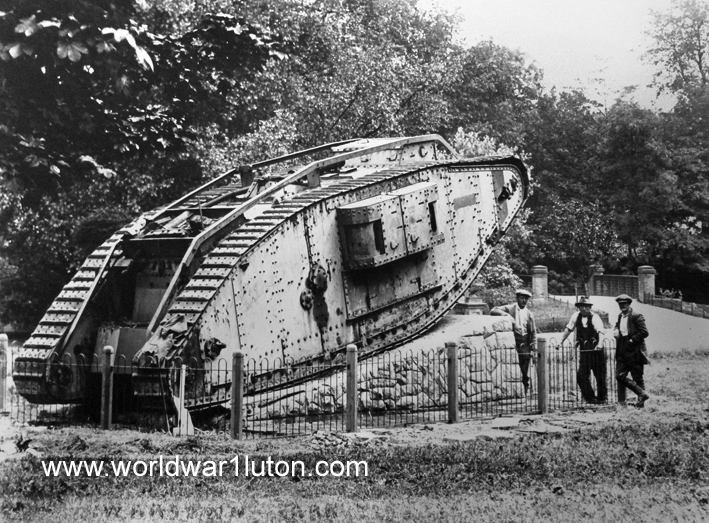
The WW1 tank presented to Luton in 1920 and positioned in Wardown Park.
The new British secret weapon known as the tank received its first mentions in a Luton newspaper. Gunner Percy Sargent ( R.G.A.), from Turvey, described in a letter seeing tanks in action on the first day of operation, September 15th, 1916, while there was speculation that an unnamed R.A.M.C. doctor reported to have given treatment under the protection of a tank positioned over a German trench was Dr William Rose, who had been a general practitioner in Luton.
Gunner Sargent, who rode in one of the tanks, wrote: "If you had seen them going into action by moonlight on the 15th you would not have wondered at Fritz bolting. They are weird instruments of war, and from what our infantry tell us they are glad we are with them instead of against them.
"We go through any shell craters, over trenches, knock trees down, and barbed wire entanglements. We simply flatten anything that comes our way.
"Of course, we get fired on well, and it is a bit thrilling to hear the bullets from machine guns rattling on the cars like hailstones, but as long as a shell does not hit us we don't fear anything else."
A Telegraph representative called on the wife of Dr Rose at her home in George Street West. She was unable to confirm the newspaper reports that it was her husband who worked under the tank in question, but that he had done so on occasions. Dr Rose had been with the Northumberland Fusiliers, although some distance from the centre of the Somme struggle.
-
So far as can be ascertained it is not yet settled whether the inspection of Volunteers by Lord French will take place at Wardown or on the People's Park tomorrow week, the Parks Committee having declined to allow the use of the cricket pitch. From the public's point of view we should say that the People's Park, either in Old Bedford Road or the old cricket pitch in Havelock Road, would be very suitable as the hillsides would provide a splendid vantage point from which the inhabitants might view the spectacle.
-
There was considerable jubilation among the members of the sub-committee of the Luton Prisoners of War Committee at the privilege of sending a couple of parcels to each prisoner of war on their books. They also received very acceptable subscriptions, including a cheque from the "N.T.F-ers," the readers of the magazine established by passengers on the Midland Railway. [N.T.F. stood for Nine Thirty-Five, the time of the evening Luton-Harpenden train used by the passengers. At the end of the war the title was acquired by the Luton News, who later produced the "Tuesday Telegraph with which is incorporated the N.T.F.". That in turn eventually became the Tuesday Pictorial.]
-
Considerable interest was manifested in a pretty wedding at St Matthew's Church on Thursday afternoon when Miss Alice Lilian Peck, eldest daughter of Mr and Mrs David Peck, of 'Ventnor,' Old Bedford Road,married Sgt Sidney Arthur Hodges, of Nailsworh, Gloucester. The bridegroom was wounded in the fighting at Hill 60 over 18 months earlier and received his discharge at Christmas 1915 after serving over 12 years with the colours. The happy couple left Luton this morning and will reside at Nailsworth.
-
After 20 months in France a couple of Luton lads belonging to the North Midland Division arrived home last Sunday evening - Gunners Marshall and Firmin, of the R.F.A. The former lives in Cambridge Street and the latter is the eldest son of Mr and Mrs Alfred Firmin, of 'Pendennis,' Dunstable Road. Both lads joined the Lincolns when they came to Luton for training with the North Midland Division on the outbreak of hostilities in August 1914.
-
Mr and Mrs Albert Firmin, of 62 Salisbury Road, Luton, on Wednesday received reassuring news of the progress of their son, Pte Hubert Firmin, of the Bedfordshire Regiment but now attached to the Royal West Surrey Regiment, with whom he was serving on September 30th when he was put out of action by severe gunshot wounds in the chest. The Matron of the 26th General Hospital at Etaples wrote to say he was seriously ill, but subsequently he was said to be "going on nicely". The 19-year-old was an employee of Hayward Tyler and Co before enlisting at the end of August 1914.
-
Pte Arthur East, the second son of Mr George East, Tythe Cottage, Leagrave, who took part in the Dardanelles Campaign and was invalided home suffering from dysentery and shell shock, is now back on active service in France.
-
The Luton and District Master Bakers' Association have decided to raise the price of bread to 9½d and 10d on Monday next, owing to the increased cost of production.
-
A terrible tragedy occurred on Thursday morning when a little boy was fatally burnt. Bert Frederick Dudley, the three-year-old son of Mr and Mrs Cyril Dudley, of 41 Collingdon Street, Luton, had been left in bed while his mother briefly visited her mother nearby. The child came downstairs and either got too near the fire or a spark flew out and set fire to his nightdress. Neighbours who heard the child's screams used a blanket and water to put out the flames, but the severely burned boy died that night in the Bute Hospital. An inquest is to be held.
-
Luton Town's George Butcher turned up straight from work in his working clothes to face a strong Southampton side which had replaced Croydon in the London Combination. It was Butcher who set up Brown to give the Blues the lead after two minutes, but the visitors equalised when Pugh had limped off the pitch. With the scores level at the interval, Luton pressed hotly in the second period and goals from Tempest and Roe make the final score 3-1 to Luton.