

Digest of stories from The Beds & Herts Saturday Telegraph: June 2nd, 1917.
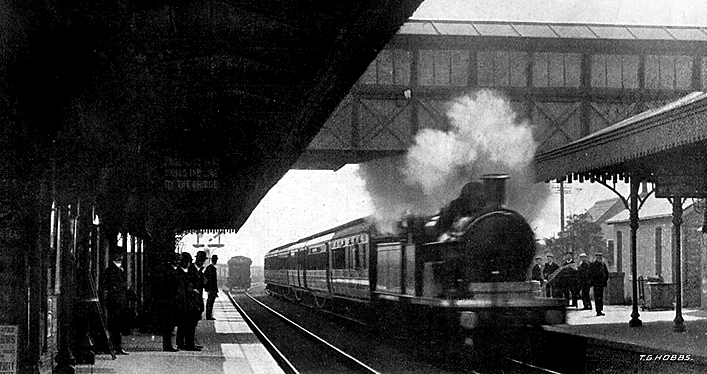
- Midland Railway station at Luton in 1907 [T. G. Hobbs].
Last night a remarkable incident occurred at the Luton Midland Station. The express to Edinburgh was stopped to put out a soldier who was in a badly injured condition, the story of which is something of a mystery.
Shortly before 10 pm Pc Simpkins was on the bridge when he heard moaning coming from the direction of the platform. He found that the 9.20 express from St Pancras had been pulled up by the guard. A soldier was put out on the platform, bleeding considerably from cuts on the left foot and the right hand and forearm.
First aid was rendered by Foreman Knight, employed on the Midland Railway, and Dr Levison was called. An ambulance was procured to take the soldier to the Bute Hospital, where about 30 stitches were inserted. The soldier had to be held as was exceedingly violent and was obviously in a delirious state.
The soldier, an Irishman belonging to the Newland Regiment, could not remember what had happened, but he had a hazy recollection of "something like a knife and a revolver". It appears that the windows of the corridor in the train were smashed.
The soldier had been in the London General Hospital since December, suffering from the effects of leg wounds. He was going to his depot at Ayr prior to returning to France. He told a Telegraph reporter that he expected that one of the men with him would be able to explain matters at the depot.
-
Second Lieut Henry George Grundy, a man who has risen from the ranks and obtained a commission, was mentioned in dispatches on May 16th for conspicuous gallantry in the field. The elder son of Mr and Mrs Henry Grundy, he had relinquished his position as a partner in the straw hat manufacturing firm of Stygall and Grundy, Buxton Road, to become a private in the Royal Garrison Artillery at the outbreak of war.
-
Further tension arose at last night's sitting of the Luton Borough Tribunal involving military Representative Lieut H. Gardner. He was rebuked for protesting that a man had been allowed three months exemption for Army service and was reminded that the military authorities were, like anyone else, litigants in a court hearing and could not alter a decision. Lieut Gardner said he would not accept that as castigation, as the Military Representative would not take a castigation from anyone. When he said he would advise the recruiting officer in the case as he thought desirable, he was warned that there must be no threats to the court. He denied he had made a threat.
-
Mrs Hankin, of 64 Ivy Road, Luton, who has lost both her sons in the war, has now received a letter from L-Cpl J. Gledhill saying he could not say for certain how her son Pte William Hankin was killed as the man who last saw him had himself been killed. He had, however, been decently buried after his body was found a week after going over the top.
-
On Whit Sunday morning, "according to ancient custom, usage and precedent," the Herald of Luton Hoo, Mr Charles Irons (pictured below), appeared at 6.30am on the east tower of St Mary's Church in his braided uniform, with uplifted staff and Bible in hand, and, facing Luton Hoo, cried loudly through his new megaphone to the winds of heaven the message of Pentecost and the King's proclamation. Mr Irons and his good lady were recently entertained at Luton Hoo, when he amused steward Mr James Baker, who like Lady Wernher is very fond of old customs and traditions, by promising to do his best to make all at the Hoo hear the proclamation.
![Town Criur Charles Irons 1907 [T.G. Hobbs]](/sites/default/files/individuals/Town%20crier%20Charles%20Irons%201907%20%28Hobbs%29.jpg)