

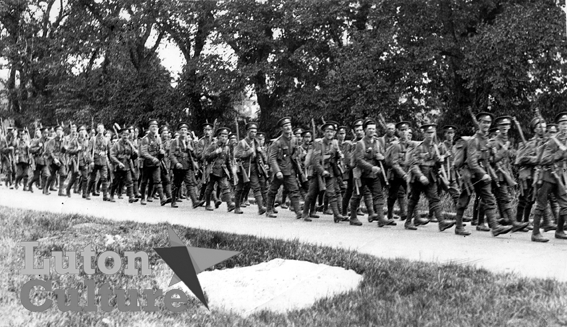
Pictured above: Men who were to become known as the Yellow Devils marching near Luton on their way to Gallipoli.
It was from his farm in Rhodesia, in a 1951 New Year greeting to old comrades, that commanding officer Lieutenant Colonel Edgar W. Brighten threw light on how the 5th Bedfords, who had won their romantic but hard-earned nickname of the Yellow Devils, nearly lost their highly-treasured and distinctive regimental flash.
In his letter, he first referred to the Battalion History description of the fighting in 1915 when the Battalion earned its nickname while storming Kidney Hill. All ranks wore a triangular yellow flash on sleeves and helmet, and a small tin triangle on their haversacks to assist the Gunners to identify them.
 It is said that a senior staff officer, watching through binoculars the steady advance of a battalion on whose backs triangles gleamed yellow in the sunlight, remarked: "By Jove! If we only had one or two more battalions of those Yellow Devils we should be across the peninsular tomorrow."
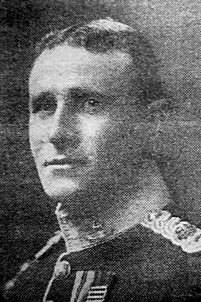
Lieut-Col Brighten (pictured, right) wrote that he originally chose flashes of primrose, one of the regimental colours, but that amber was the nearest colour obtainable.
"I made the most of our newly gained nickname to maintain our own esprit de corps," he wrote. "Thus every individual in the Battalion became proud to wear the yellow flash which designated him as one of the Yellow Devils."
About two years later, however, the battalion came near to losing its flash when regimental flashes were "regularised". Knowing how much the morale of the unit centred about the yellow triangle, Lieut-Col Brighten resisted the change.
Finally, when all else failed, he refused to use regimental funds to pay for what would be Divisional flashes. This ultimatum had the desired effect.
And thus the Yellow Devils kept their flashes and their morale.
[Beds & Herts Saturday Telegraph, January 6th, 1951]