

Private Cyril Bunyan, who had enlisted with the North Midland Royal Field Artillery stationed in Luton after escaping from occupied Brussels, had told The Luton News about what life was like in the Belgian capital following the German occupation. In this final episode of his story he talks of his dash for liberty via Holland and the narrow squeaks along the way.
"After three months I resolved to make a bid for liberty. I had only been able to leave the house after dark and move about in lonely places. In order to conceal my identity as much as possible from the prowling spies, I had allowed my moustache to grow, and so one morning I rigged myself out as a Belgian farm labourer and boldly took the train for Vilvorde.
"Whenever sentries were signalled I alighted and walked a short distance, and eventually got to Vilvorde, and then out into the country where the fighting had taken place. What I had known as a pretty little village called Eppingem [Eppegem] was practically razed to the ground. In a straight line in the village were the graves of Belgian soldiers, and a short distance away the grave of a German officer. The field around Eppingem contained long lines of trenches, and scattered about the place were the ruins of houses which had been brought to the ground and utilised as beds for the big guns.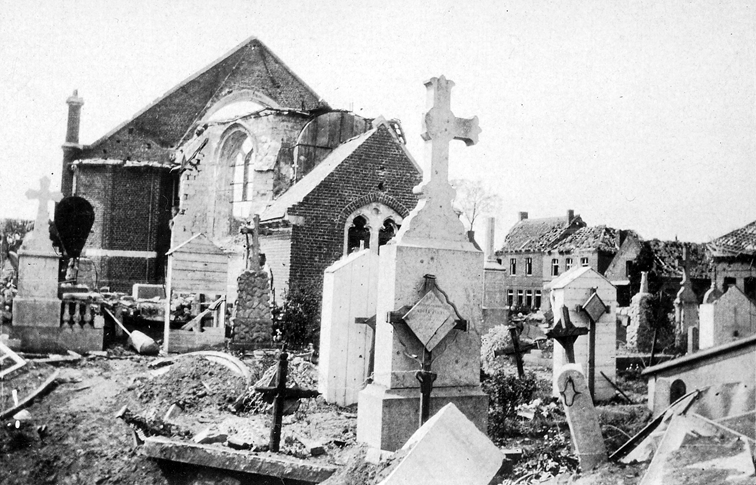
[The picture, right, is intended only as an illustration of the type of damage suffered by battlefield villages].
"From Eppingem I made my way to Malines, the town that has suffered so badly, although the loss of life has been very small. There were thousands of German soldiers here, where the station and other public buildings have been practically wiped out. The damage is almost incredible.
"It was very difficult to leave Malines for the soldiery was far larger than at Antwerp, and I had sentries to dodge about every mile. Particularly well guarded were the bridges, but my disguise began to look more like that of a farm labourer and I got through, and eventually arrived at the outskirts of Antwerp. The fields and woods in the vicinity were strewn with equipment and the telegraph wires were cut.
"Here I had a narrow escape. A little distance from the bridge which I had to cross a group of Germans were trying to light a fire. I was nearly across the bridge when a sentry called out to me to halt, and he raised his rifle to his shoulder. It was useless attempting to bolt, so I obeyed and, when he asked me where I was going, I replied in Flemish that I was going to work. At the same time I put a penny in a charity box, and was allowed to proceed. That penny was a cheap passport.
"Many of the outer forts of Antwerp were little damaged, but numerous holes in the earth showed where the shells from the big guns had fallen. A number of Uhlans came up, so I slipped into a cafe and waited until they had passed.
"A Belgian farmer informed me that there was only one train to Antwerp which was not searched by the Germans and I was able to take this train. To my dismay I learned that we had to change. and there were many troops about. This was a particularly dangerous period for me, as I was now in a fortified area and there is no doubt that had my identity been discovered I would have been shot as a spy.
"Luckily for me I met a man I knew, and this cheered me until I found myself on the Antwerp train. We passed many guns that were being conveyed to the forts, all of which have been rebuilt and refitted. There were bills all over the place asking for Belgian workmen for rebuilding the forts, and the wages offered them were on a magnificent scale - 40 centimes (about 4d) per hour.
"In Antwerp I met a Belgian friend who had crossed the frontier from Holland. He had been shot at by the German sentries, and he tried to dissuade me from attempting to cross the frontier at night, owing to the numerous bands of marauding Uhlans.
"Antwerp has suffered comparatively little from the bombardment. A few big houses on the main boulevard were damaged, but the shops had escaped very well. But it was evident that the city was under similar ruthless and strict administration as Brussels. German soldiers and sailors were all over the place, and the public affairs, railways etc, are managed just the same as in Germany.
"After passing the night at a cafe, I set out for the frontier with a better heart than at any previous stage of the journey, for I had gained confidence in my disguise - I needed it too.
"The most difficult task, apart from the crossing of the frontier, faced me when I had to cross the River Scheldt. On the bridge two sentries were posted, for that is the main road for leaving the town, and every person must produce a passport before he is allowed over the bridge. Many had crossed by means of false passports, but the only thing at my disposal was a football card which bore the words, "Laissez passez". By the will of providence it was raining in torrents, and I felt that I should never have a better chance, so I resolved to bluff it out. I stepped towards the two sentries and, drawing out my card, murmured in Flemish that it was all right, and went straight ahead. They allowed me to go, but I never breathed freely until I was out of sight.
"Eventually I came to a place called Blue Farm, and in a cafe there came across two Uhlans who were drunk. They were also waiting for an opportunity to cross the frontier. Forty of their comrades had crossed the previous day, and the two told us they were 'fed up' and wanted to get out of it. Of course, I never revealed my identity.
"In the cafe was a bag belonging to a girl who tried to cross the frontier. She was shot dead in the act of crossing, and her dead body fell into Holland while the bag dropped in Belgium.
"Our small party next went on to a little village where we were met by a party of Uhlans who engaged us in conversation, but we were permitted to proceed, the Uhlans evidently placing strong faith in their frontier sentries.
"We then struck the road to Capelle [Kapellen?], and here we saw a party of Uhlans trying to conceal themselves behind some trees. A farm was close at hand and I bolted into the yards and into a barn. Throwing off my coat, I seized a rake and began pulling some hay together. One of the Uhlans came searching round and, after staring at me for a moment, he went away.
"I waited for the party to clear off and had arrived within a mile-and-a-half of the frontier when I came across a party of men and women waiting until under cover of darkness they could cross the frontier.
"At dark we began the final stage of our journey, guided by the light of the Dutch customs office. It was raining in torrents, but bearing in mind that the rain had been my salvation at Antwerp, I was encouraged by the hope that it might prove equally serviceable again.
"We met in this last stage a party of refugees, including a number of infants. They were drenched with rain and had lost their way. They had met some man who had promised to take them over the frontier for the sum of 20 francs, but on reaching the frontier wires they were spotted by the German sentries, who opened fire upon them and they had been compelled to go back to Charleroi. Women who are caught, are sent back, but if men are caught they are shot out of hand.
"A little farther on we met a man in civilian clothes who addressed us in very bad French, telling us to go back. He wore a mackintosh and carried a bag, but it was evident he was neither Belgian nor French. Said one of the party, 'You're English, are you not?' and he answered 'Yes I am'. It was on the tip of my tongue to speak in English but his next remark betrayed him and I kept quiet. He was a German officer in disguise.
"To cross the frontier was now the task, and there were all sorts of traps laid to catch the unwary. Deep holes, ditches full of water had to be negotiated, and as there were several ladies present it was no easy task. We managed, however, to reach the first fence of barbed wire, which is plaited and crossed and interwoven, and it was a terrible job to get the ladies across.
"We had just got within 50 yards of the frontier line when one of the ladies fell into a deep ditch. Of course, it was too much for her composure and she screamed. The German sentries shouted and fired as we pulled her out of the water and rushed across the short space in a record sprint. Nine shots were fired, and one bullet just missed my head.
"We were just in time. As we stepped over the low fence into Holland a party of Dutch soldiers hauled us foward at the very moment the Germans threw full upon us their powerful searchlight. The clothing of the ladies was almost completely torn off by the wires.
"After giving us bread and butter and tea, the Dutch soldiers gave us two guides to take us to the first village, but before reaching there we were informed that five English ladies had attempted to cross after us and four had been killed.
"Such is the story of my escape. It may be, and I hope it will, that providence will smile upon me when I am again endeavouring to defeat the Germans, for I hope to cross over very shortly with my regiment, the North Midland Royal Field Artillery."
[The following weekend's edition of the Beds & Herts Saturday Telegraph said that although Pte Bunyan's family were brought up in Derbyshire, his family roots were in Bedfordshire. The oldest living member of that branch of the family was his grandmother, who was living in Chesterfield.
[Source: The Luton News, February 18th, 1915]