

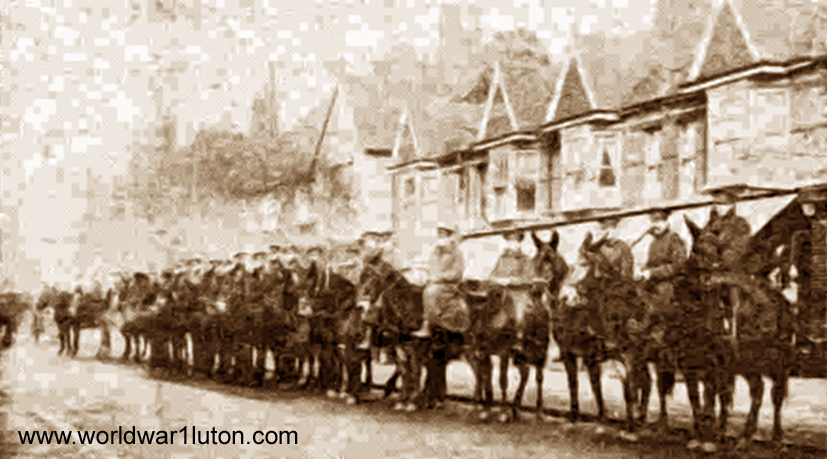
This picture should be historic for Luton, said the Beds Advertiser. The sight of a long line of mules going through the town each morning will be unknown after the war. The mules are fine specimens, and belong to the Army Service Corps billeted at Biscot. Our photographer secured the picture at the corner of Leagrave and Dunstable roads.
A report by an agricultural correspondent said the shortage of horses in the country and the number of mules which have been imported for war purposes had combined to arouse considerably greater interest in mules, which are, of course, hybrids between the male ass and the mare.
The cross is sometimes reversed, the progeny then known as a hinny, being generally smaller than a mule and less desirable in every way. For producing the largest and finest mules, Andalusian and Majorcan jacks are used.
In countries like the United States, where mules are commonly used, the market prices for them are uniformly higher than those of horses, so that the industry of rearing them is usually a profitable one. The animals can be used for any kind of work for which horses are adapted, and for several other sorts besides.
They excel horses in capacity for work, endurance, length of life, economy in feeding and freedom from disease, and in emergencies mules have worked for 24 hours without water and for two or three days without food without serious results.
Mules require much the same care and feeding as horses, but do not require so much food. Experiment has shown that three mules can eat about the same amount as two horses of like weight, and on these rations keep in as good or better condition than the horses.
The size of the mules seems, on the whole, to be inherited from the mare, so that the selection of mares is very important.
[Beds Advertiser: Friday, November 19th, 1915, and December 3rd, 1915]