

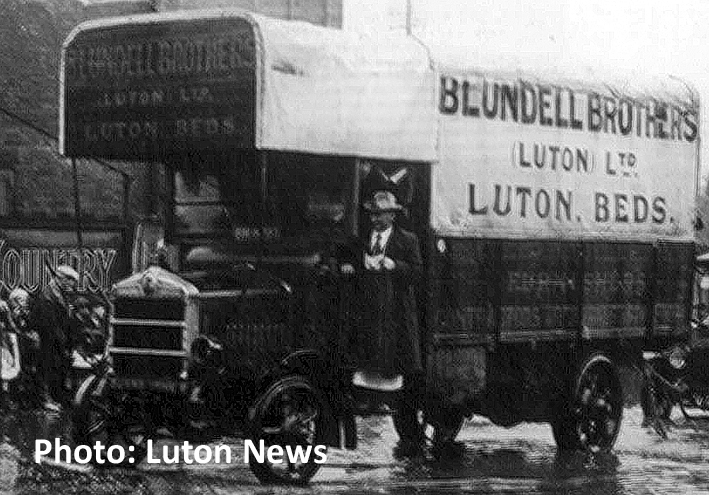
- An extension above the driver's cab allowed additional cargo to be carried (1924 picture).
If we may judge by the general aspect of the town, Luton is passing through a period of business activity. As the railways are somewhat hampered by Government restriction, private firms are finding a solution of the difficulty of transit by providing their own automobiles for conveying hats from Luton to their City warehouses.
It is reported also that goods are despatched to the large business centres at Birmingham and Manchester, and other towns, by private conveyances. This is an illustration of the initiative and enterprise of the leading local firms.
Usually during the autumn there is considerable activity in the production of velvet and velour hats, but this year public taste had diverged from these, and felts apparently take the lead.
Straw hats for the coming season are engaging the attention of some City buyers. Large orders are being placed, and it is to be hopes that these early commissions will strike the right note, both as to shape and materials.
The military situation dominates the styles shown in the crowns, but the brims exhibit considerable variations, ranging from diminutive to fairly large proportions. The materials for the better classes of goods are tagals or various makes, an imitation Liserie called 'Mackinaw' and, for the most expensive, Chinese and Swiss Liserie.
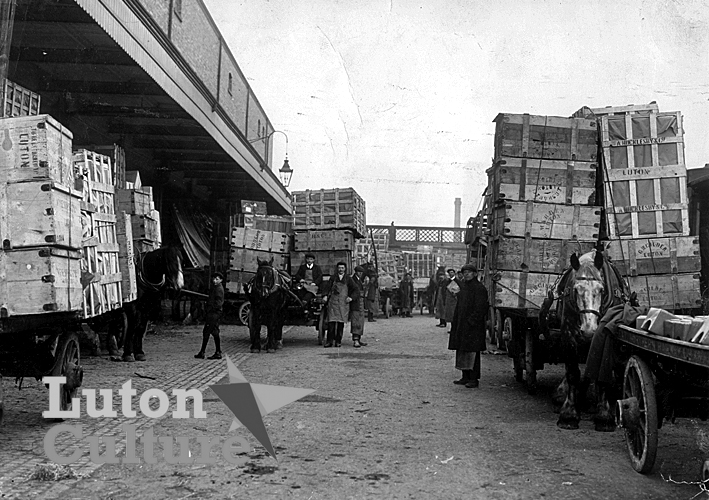
- Hat boxes awaiting trains at Luton in pre-war days.
The demand for expensive hats shows no sign of diminution, nor is it likely to diminish so long as the operative classes can earn the high wages connected with munition work. At present there is no indications of the termination of hostilities, but when peace is eventually assured there will probably be a social revolution, resulting from reduced opportunities of earning high wages.
There are indications that, owing to the risks of ocean traffic, there will soon be an acute shortage of straw plait. Already prices are soaring far above the average, and those plait merchants who have the capital can retain the visible supplies till they can make an exorbitant profit. This constitutes a serious situation for those firms who have sent out samples based on previous prices, and will have to execute orders taken at the original quotations, irrespective of the present values of the raw material.
The sample orders for Canada have been despatched for about two months, and by this period of the year orders have usually been received for that market. They generally reach Luton before the season opens for the home trade, but this year the latter is the first to operate. The situation suggests that the buyers for the City wholesale houses think that unless they order early there will be a shortage when the season fairly opens.
The disastrous fire at the premises of Messrs Wing, Arnold & Wing that destroyed the warehouse and its contained large stock of hats occurs at a time when it will be possible to make due preparation for the spring trade of 1918. One notices with interest that commodious premises have been secured by this firm in King Street, and that business is being carried on with characteristic energy.
The question of the supply of raw material for the making of straw hats presents a serious problem. In past years Germany sent us an abundance of certain machine-made braids, but that market is closed. Switzerland is pushing its special products, but here the supply is restricted, either wisely or unwisely. It is desirable, both for Switzerland and this district that unnecessary restrictions should be removed. Our productive powers should have full play because, under the most favourable circumstances, Luton will find its business capacity restricted by the number of operatives who are engaged on Government work or are at the Front.
In the October returns of the Board of Trade it is stated that our imports were nearly the double of our exports, the latter 50 millions and the former 90 millions. How far the diminished shipping trade affects Luton is not indicated, but in any case it is serious.
[The Luton News: Thursday, November 29th, 1917]