

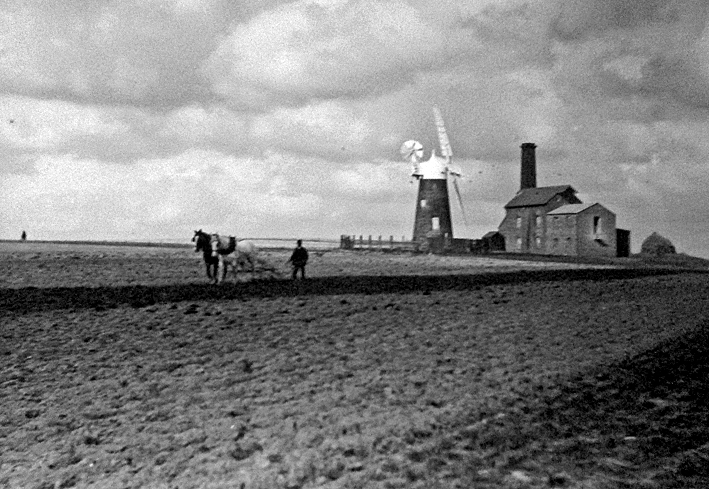
- Mill Fields, Houghton Regis, c1900.
With a bullet through his brain, Regimental Quartermaster-Sgt Charles Francis Hipperson was found dead in a field on Sunday, January 19th, 1919. He had been missing from the Royal Engineers Signal School at Houghton Regis since 11.30 the previous morning.
An inquest the following Tuesday would hear of the ultimately tragic effects of shell shock on the soldier after he went to France on August 16th, 1914, and was in the retreat from Mons. The Tuesday Telegraph (January 21st, 1919) took up the story.
Houghton Regis Mr Scroggs was called out by one of his men, Joseph Robinson, who informed him he had found a man lying in Mill Fields who looked as though he was dead, so blue was his face. Mr Scroggs, a sergeant in the Special Constabulary, found QMS Hipperson lying in a pool of blood with a 'Webley' service revolver just under his body. Police from Dunstable removed the body on a stretcher to the Camp, where Dr Harold Little pronounced life extinct.
Norfolk-born Charles Hipperson had been in the Army since 1902 but it was when sent to France in 1914 that he suffered shell shock. He was continually feeling the effects of this, and had complained on the Saturday of internal pain and headache.
He had been at Houghton Camp for nearly three years, living with wife Mary and sons Henry and Charles at 5 Queen Street, Houghton. He had also lived at the neighbouring village of Bidwell some years previously.
The Telegraph report said that by nature QMS Hipperson was a quiet, steady man who divided his time between military duties and home. His military record was perfect and the Adjutant at the camp testified to his conduct as absolutely exemplary. He had done his duty faithfully and had left everything in perfect order.
First witness at an inquest the following Tuesday at the King's Arms, Houghton Regis, was Coy QMS R. W. Holliday, stationed at Houghton Regis, who identified the body. He knew QMS Hipperson well, having been acquainted with him since April 1916. His age was 35.
Deceased had told him he had taken part in the retreat from Mons and had been invalided out with shell shock and internal trouble. Replying to Coroner Mr G. J. M. Whyley QMS Holliday said the deceased had complained frequently of severe pains in the head and had seen him for three hours at a stretch with his hands over his head, unable to move.
Witness said he had frequently advised QMS Hipperson to seek medical advice – the last time on the previous Friday. It was about 11 in the morning of Saturday that he last saw the deceased, and he then appeared to be in his usual health. He seemed most devotedly attached to his wife and family.
Dr Little said that when summoned on Sunday afternoon he found the body lying in the hospital hut at the camp. Death had taken place not less than 12 and not more than 24 hours previously.
On examining the body he found the head covered with blood and a wound in the right temple caused by the entrance of a bullet at close quarters, and another wound over the lobe of the left ear. The scalp over the right temple was scorched by powder. The wounds were such as could have been self-inflicted, and death was in all probability instantaneous.
A revolver was produced, and the doctor said the wounds might have been inflicted by such a weapon. There were no other marks upon the body, which was well developed and nourished. He had never attended the man.
Joseph Robinson, a farm labourer, of 141 High Street, Houghton Regis, said he was walking on a footpath across Mill Fields, towards Houghton Regis when he noticed the body of a soldier almost on the footpath.
Farmer Mr J. C. Scroggs said he responded to a call to go to Mill Fields at about 12.30 on Sunday. He saw the body, which was fully dressed, lying slightly on its left side, with part of the left side of the face hidden from view. He lifted up part of the overcoat which deceased was wearing and saw the revolver lying under the body and near the right hand. The man appeared to be quite dead. There was no signs of a struggle.
The footpath was well frequented in the ordinary way, but at the time in question was very muddy. There would not have been many passers-by just then.
Capt J. A. Weston, of the Army Signal School. Said he spoke to the deceased early on Saturday morning to arrange to see him at one o'clock to start the checking of the stores. Deceased did not turn up, but Capt Weston found the books and everything quite in order. Deceased was most conscientious about his work.
Capt Weston gave details of QMS Hipperson's military career. He enlisted for 21 years with the colours on January 23rd, 1902, and went to France in August 1914. He returned to England on July 20th, 1915. The military record made no mention of the reason for his return, except to state that he suffered from general debility and was found not fit for active service.
Summing up, the Coroner said the only conclusion at which he could arrive was that the deceased died from the effects of wounds caused by a revolver and self-inflicted. Taking into consideration the history of deceased, it would seem that he at the time was temporarily insane and not responsible for actions. The insanity was caused by shell shock sustained on military service.
QMS Hipperson's brother, Captain G. Hipperson, from Aldershot, was among those who attended the inquest hearing.
[Beds & Herts Tuesday Telegraph: January 21st, 1919]