

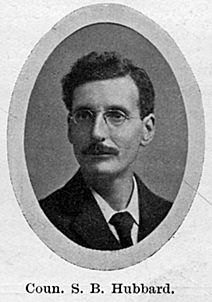
Businessman Stewart Butler Hubbard, recently returned from a trip to France, Switzerland and Italy on behalf of the Luton dyeing industry, gave The Luton News an interview outlining his experiences and explaining the difficulties of travelling through Europe in a time of war. Here are extracts.
Directly one sets foot in France, said Councillor Hubbard, one realises what war really means. In the first instance one has to be at Victoria Station an hour before the train leaves, and go before two gentlemen who want to know who you are, where you are going, what your business is, whether you are carrying documents or letters - if so, they have to be produced and read - and other pertinent things. The same thing occurs at Folkestone, and you cannot get off the quay until your passport has been scrutinised.
 At Dieppe one has to go through the same thing again, except that the examination is even more searching. Then comes an immediate appeal for a contribution to the Red Cross funds. Not one, but perhaps 20 ladies come on the train to solicit subscriptions, and they get something from every compartment. At every stoppage on the way to Paris these girls canvass the whole train, and it is no use saying someone else has given. The reply is, "Yes, that may be, but you have not given to me." If they only get a five centimes piece they are satisfied, but they persist until they get something.
The dead appearance of Paris at evening time was commented upon by Mr Hubbard, points mentioned being cafes closed at eight o'clock, streets practically in darkness, and an almost entire absence of the usual street traffic. During a journey of probably three miles from the Gare St Lazare, through the Avenue de l'Opera and other important thoroughfares, he did not see 50 people walking in the streets or 50 vehicles of all descriptions. This was Paris at 9 pm, and it made one realise what war really meant.
"I wanted to send a telegram to England to say I had reached Paris safely," said Mr Hubbard. "I was sent from the telegraph office to the police headquarters, and had to show my passport, provide a copy of the telegram in French, and get a permit. Not until this had been done could the telegram be sent, and it was the same everywhere in France when a foreigner wanted to send a wire."
There are only four frontier stations through which travellers can pass from France to Switzerland or Italy. Only can only go via Pontarlier or via Bellegarde and Geneva into Switzeland, and only by the Monte Cenis route or via Ventimille [Ventimiglia] and the Riviera route into Italy.
The Pontarlier route is the most favoured, as the time between Paris and Milan does not much exceed the normal. This service has much improved since October-November, when it took four days and sometimes more. Now it takes about 18 hours.
The Customs examination at the French frontier takes about three hours. "Not only are your passports examined closely," said Mr Hubbard, "but you have to give a general and very complete account of yourself, and if you have stayed in France any time since the passport was last viséd you have to give documentary proof of what you have been doing. If you haven't got it, you just have top wait until you can get it. I met someone who was in that position."
Switzerland, said Mr Hubbard, is quite empty of the crowd of English people who usually go there for the winter sports, and this little country is having a particularly bad time of it just now. A great many of the manufactures of the country of purely local importance are hit very badly. Firms that supply the English market and have representatives in England, on the other hand, are fairly busy.
In the earlier stages of the war all the frontiers were blocked, no food was coming into the country, and in some of the country districts people were so alarmed that they were almost afraid to eat such food as they had in stock. The price of beard today is very high, said Mr Hubbard, and the quality of that which is delivered under the description of "family bread" is such that I think few people in Luton would eat it. The inside of the loaf is the same colour as the outside of ours.
For winter sports Switzerland has had ideal weather, but this important source of income has been quite killed for the present by the war.
At the end of his European trip Mr Hubbard made his way back from Italy via Geneva and Bellegarde in Switzerland into France. The route gave him some idea of the the trials which the Allied troops have been undergoing owing to the terrible weather which had prevailed during the fortnight preceding his journey. This was made up of deluges of rain, blinding snowstorms and frost which sometimes sent the thermometer down to 10 degrees F below - 42 degrees of frost.
Re-entering France, according to Mr Hubbard, was more difficult than getting out of it. At the frontier station the sheep and goats were separated, there being one set of examiners for French people and another for foreigners' passports, and documents were subjected to the severest possible scrutiny. One had to be able to give a most detailed account of movements and business.
Then every small station on the line had its hospital for wounded soldiers, and at every stoppage subscriptions were solicited. At one little station alone during the months of December and January, 7,000 francs were collected in this way, and Mr Hubbard thought something of the kind might be done in this country as a lot of money might be raised in small sums which no one would miss He added that it might not be as disadvantage for the Red Cross Hospital at Wardown to try this method, if it were permitted.
A pathetic scene at Lyons was described by Mr Hubbard. He went to a service at the Cathedral, and of the 2,000 worshippers not more than 100 were men, while the congregation included quite 1,800 ladies in mourning. In the whole town quite 30 per cent of the women were in mourning for someone or other.
[Source: The Luton News, February 25th, 1915]