

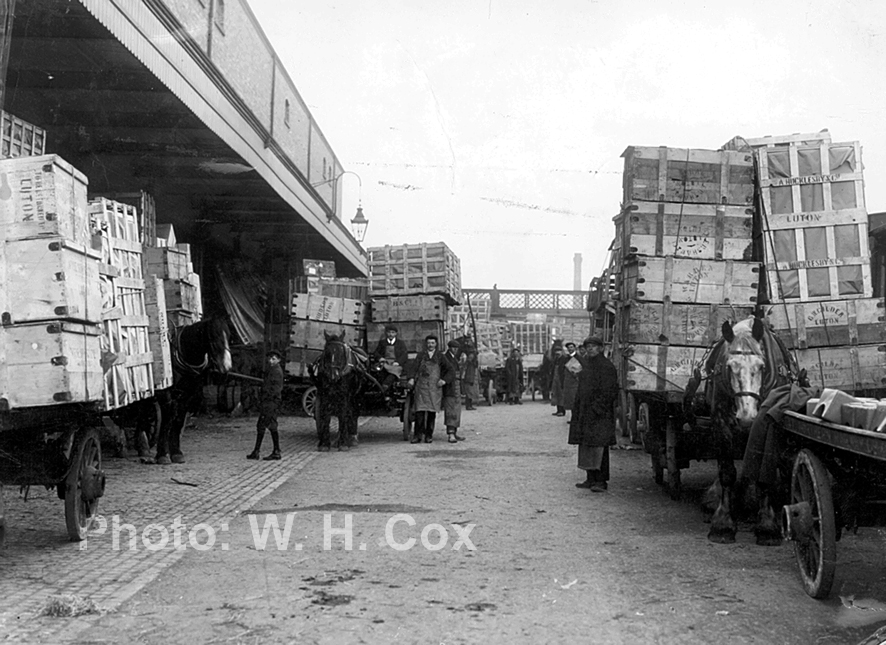
- Hat boxes delivered to the railway station in the pre-war heyday.
There has been a good deal of apprehension in the straw trade locally, especially among operatives, concerning the position of the staple industry under Mr Neville Chamberlain's scheme of National Service, and this will probably be allayed to some extent by the assurance of the Mayor of Luton that there is no need for anything like a panic in the trade.
In consequence of an inquiry from Mr Chamberlain as to the steps being taken in Luton to start the scheme, the Mayor and the Town Clerk paid a visit to the National Service Department in London on Thursday and saw Mr Hiley, the Deputy Director-General. The general effect of the interview was communicated by the Mayor to a meeting of the Chamber of Commerce on Friday evening.
The point raised by the Mayor was as to the position in which the Luton trade and allied industries stood in relation to work of national importance for the purpose of the classification of trades. He emphasised that there was practically no residential population, and it was practically impossible for Luton to provide for the National Service scheme anything like the number of men and women that might be thought available from a town of its size if the local industry was to be maintained at all, and the contention he advanced was that they should be allowed to maintain the industry as far as they could.
The information obtained in reply was that the hat industry would be scheduled, and would be allowed an amount of labour which the Director General, after consultation, thought they were entitled to keep, but over and above that they were not expected to employ any more, and the Mayor said his impression was that they were not going to be so seriously disturbed as people had been prepared to think.
There was a flutter in straw trade circles on Saturday when it was found the official list of goods whose importation is prohibited, except under Board of Trade licence, includes hats and bonnets, straw plaiting, artificial flowers, ornamental feathers, manufactures of silk, and skins and furs.
All these are articles which, in some form or another, constitute the raw material for the local staple industry, but some consolation is afforded in the fact that the prohibition is not altogether total, in the sense that it will be open to the Board of Trade to issue licences. There is a feeling that this may meet Luton's case, for if the effect is merely to restrict imports the industry is in the happy position of having available sufficient stocks to be able to carry on for some time.
At the instance of the Mayor the export plait merchants were hurriedly called together on Saturday evening to consider the situation, and as a result of the deliberations it was decided to send the Trade an official statement of the position.
The statement, which is signed by the Mayor of Luton (Alderman John H. Staddon), the President (Mr F. W. Plummer) and Secretary (Mr T. Keens) of the Chamber of Commerce, was drafted this morning and reads as follow:
"Prohibition of imports of straw plait. This matter has had the careful consideration of Luton plait merchants. The classification of the Board of Trade "plaiting of straw and other materials" clearly indicates that all plaits are included under the prohibition. Under previous prohibitions, relating to other materials, importation by licence of the Board of Trade has been allowed, though the quantities have been restricted.
"It may be possible by the same means to make good the deficiencies in this trade. Whether this will apply to plait or not, the merchants are confident that the general stocks in hand and the shipments now upon the water bound for this country are sufficient to ensure the fulfilment of the requirements of the hat trade for, at any rate, the present season, and even well into the next.
"There is therefore no cause for alarm on the part of the operatives engaged on the ground of the shortage of materials.
"The merchants, however, desire to warn their customers that it may not be possible to execute orders for all materials, and that if there should be a shortage and a limited number of articles, they are of opinion that substitution can be made without detriment to the customer."
[The Luton Reporter: Monday, February 26th, 1917]