

With the loss of hundreds of thousands of potential customers - the men in the forces - Luton's boater trade was incensed by a new recruiting poster about to be released in the summer of 1915, showing a straw hat and a khaki service cap and the wording, "Which ought you to wear?"
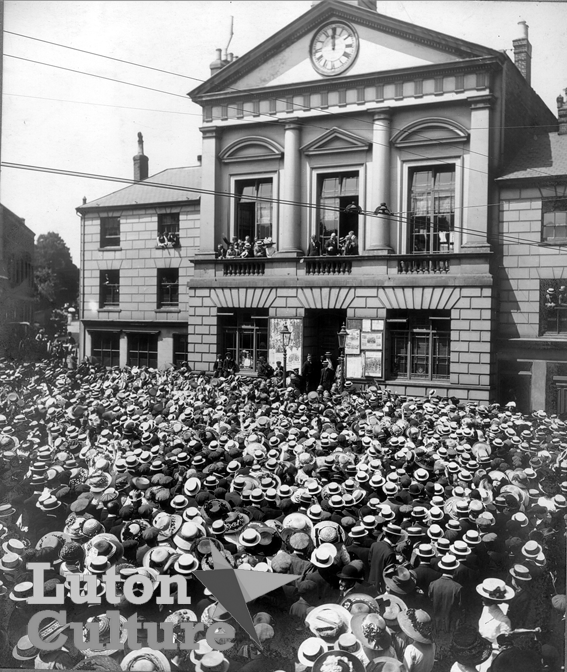 The poster, they thought, would seriously damage the boater trade, which had already suffered a severe diminution with so many men having joined the colours and taken themselves out of the ranks of the straw hat wearers. It would also prejudice the wearing of the boater, even among men who were not eligible for the Army, and the damage done to an important industry would be out of all proportion to any immediate gain to recruiting. [The pre-war popularity of the boater was shown in the picture, right, taken at the declaration of the 1911 Parliamentary by-election result in Luton.]
Luton Chamber of Commerce President Mr Harry Inwards addressed a protest letter to the War Office and to the Parliamentary Recruiting Committee. In it he wrote:
"My Chamber and most of its members have been, both before and during the war, actively engaged in promoting recruiting. Before the war for the Territorial Forces, and since the war for all branches of the service, the committee of which I am secretary has been instrumental in providing upwards of 3,000 men for His Majesty's Forces.
"It cannot therefore be suggested that in offering any observations I am in any sense lukewarm about obtaining recruits, and the prosecution of the war in the most vigorous manner.
"What I suggest, and what my Chamber strongly feels, is that the issue of such a poster will tend to seriously still further damage an important industry, which has already suffered very considerably through war conditions, as will readily be understood from the large number of men who would ordinarily wear straw hats now serving in His Majesty's Army.
"While not denying that some slackers may be wearing straw hats, it is obvious that the mere wearing of the hat does not make the man a slacker, nor refraining from wearing it change his nature.
"Further, there are hundreds of thousands of men either of military age, or under military age, engaged in the necessary services of the community, who may be deterred from wearing what is obviously the best and most hygienic headwear during the summer months.
"That this is not the object of the War Office is frankly admitted, but that it will have that effect I am afraid is beyond doubt. I trust, therefore, that you will see your way to withdraw anything calculated to still further damage this most important industry."
[Beds & Herts Saturday Telegraph, May 22nd, 1915]