

Gunner Henry Charles Martin, Royal Garrison Artillery, whose wife died from a stab in the throat inflicted by her husband at 6 Queen Square, Luton, on October 4th, was at Bedfordshire Assized on Monday [October 18th, 1915] found not guilty of murder, for which he was arraigned, but guilty of manslaughter, the jury adding that when he committed the act which caused his wife's death he did so under very great provocation.
Sir Ryland Atkins, in opening for the Crown, said the story to be laid before the jury was short and sad. The facts were few in number and, he submitted, absolutely clear.
Since the war began prisoner, aged 36, joined the Royal Garrison Artillery, and he was serving at Stratford, East London. His 32-year-old wife and three children were living at 6 Queen Square, Luton, and it was his custom to spend weekends with his family when he obtained leave.
The day on which this tragedy occurred was Monday, October 4th. Prisoner had come down to Luton on Saturday, and stayed the weekend with his family. There had been matters of family trouble between him and his wife, but for the preceding fortnight these differences had not been so acute. At any rate the jury would hear that there was no sign, sound or evidence of any quarrel.
The jury might think - it was for them - that the previous disagreement of the question of the wife's fidelity was in prisoner's mind as a motive, or helped to form a motive for the act, but counsel repeated that when the tragedy happened there was no evidence whatever of any quarrel of any kind or even "words".
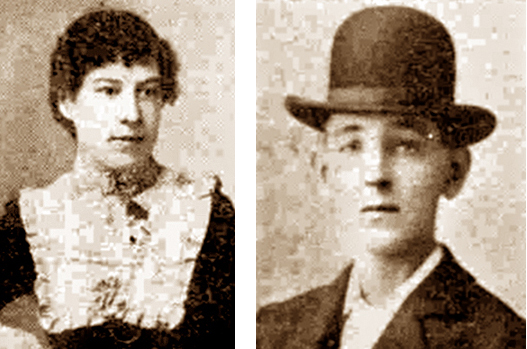 On Monday prisoner went out of the house at 6.30 and said to a constable, "I had better come with you, I have done my wife in." A little boy was roused by sounds, and found his mother bleeding from the neck. He did his best to staunch the flow of blood, and so also did a neighbour.
A doctor found found that the woman was suffering from a stab in the side of the neck, and she was taken to the hospital, where she died. The doctors said that the cause of death was a severed vein, and this was probably severed when the knife was drawn out, and not during the actual stab. The knife was found in the bedroom.
[Amy and Henry Martin are pictured right]
Counsel quoted statements afterwards made by prisoner, including that to the constable, and then said that the thing he wanted to impress upon the jury at the present was that the woman died from violence; she died from the stab of a knife inflicted by her husband.
The husband might have had a motive for that in his wife's previous conduct, but there was no evidence of any quarrel or struggle.
Counsel said that if the evidence bore out his instructions, he would submit to the jury, subject to his Lordship's ruling [Mr Justice Shearing], that prisoner was guilty of murder. The jury was called upon to discharge the gravest duty that could come to them, and their only safe guide was a conscious, vigorous exercise of reason. Neither sympathy for the man nor the woman should be allowed to turn their judgment or from giving most careful attention to the case and deciding strictly according to what was true.
Eldest son Charles William Martin said that up to Whitsun they were living at Barking and all very comfortable together. At Whitsun they came to Luton for a holiday, and stayed with his grandfather, Mr Plummer, of Blythe Place. His father only stayed for the Bank Holiday, but the rest of them stopped a week.
In that week he saw his mother and a soldier named Newbury, who belonged to a regiment then stationed in Luton, kissing each other at times. When they got back to Barking there was trouble about Newbury.
Soon after that his father joined the Army, and the rest of them came down to Luton and for a time lived at Blythe Place, where Newbury was still billeted. The boy confirmed that his mother and Newbury continued as before.
After five or six weeks, said witness, his mother took a house at 6 Queen Square. Newbury used to visit her there and be on very friendly terms with her. After his mother had done the housework she used to go upstairs and lie down and Newbury used to go with her. That happened very often, while he also used to be there for meals.
Asked by Mr J. F. Eales (instructed by Mr F. W. Lathom for the defence), what happened with regard to Newbury when his father came down for a weekend, the son said his mother used to send letters to Stockwood Camp to tell him to keep away. He and his brother Albert took the letters.
He said his father had once wanted to find Newbury, but Newbury always kept out of the way.
He heard his mother tell his father she was going to Australia with Newbury. All the trouble since Whitsun was over Newbury. His father had always been a good father and fond of the deceased.
Re-examined, the boy said he had only once seen his parents quarrel over Newbury.
Evidence given at earlier hearings was heard from neighbours, doctors and police officers before Martin went into the witness box to give his version of events leading up to and on that Monday morning.
He said he was married 13 years ago in Luton, and had three children. He worked at the Langley Foundry and for Brown and Green Ltd, and about 3½ years ago went to Barking to work for the London Scottish Foundry Ltd. He worked there until he joined the Army.
Except for a few small tiffs, said the prisoner, he lived very happily with his wife and children until last Whitsun. He was doing fairly well, earning £2 8s and overtime, and with the help of his wife saved up £28, which was kept in the house in cash.
He referred to the visit to Blythe Place at Whitsun, and said there were two soldiers billeted there. His wife and children stayed a week, and on the night they returned he asked her to go to the pictures, as it was their custom to go twice a week. She refused.
He then asked her about her Mizpah brooch as its centre, which was inscribed 'God bless thee and me while we are absent one from another' was missing. At first she said it dropped out at a dance and was trodden on, but later she admitted she had given it to Newbury.
Shortly afterwards he enlisted, and his wife and children returned to Luton. She said she was going back to enjoy herself and that she loved Newbury, and that it was too late for prisoner to appeal to her as she had made a vow to Newbury. He tried to induce her to give up Newbury, but without success.
He wrote to her at Blythe Place, and six weeks later came to Luton himself. Then he found that although her letters to him had been addressed from Blythe Place she was not living there, but at Queen Square. He went to 6 Queen Square and, although he could not get an answer, he saw on looking through the window that it was his home, as his furniture was there.
He knocked at the front still without getting an answer, and when he went to the back again the blind had been pulled down. He gave it up as a bad job and spent the night with a friend.
Next morning he went to see his wife, questioned her about the use to which she was putting the house, and said he thought to go and see Chief Constable Teale.
She burst out crying, and promised to give Newbury up is prisoner would return her ring. The explanation of this was that before she left Barking she threw her wedding ring at him when she said she was going back to Luton to enjoy herself, and until she asked him to return the ring on this occasion it had been in his possession. This was on August Bank Holiday, and he gave her the ring again.
Later he heard something of what had been going on, and in the presence of his sister, Mrs Barton, he questioned his wife, who admitted that she had sent a soldier cigarettes and handkerchiefs, and that while she was at Blythe Place her brother found her in a compromising position with Newbury in the middle of the night. She promised then that she would give Newbury up.
Prisoner said he was still fond of his wife, but a fortnight before the fatal day she said she was going to Australia with Newbury, and was going to take Gracie (prisoner's little daughter) with her. When he reprimanded her for her conduct she made a dash at him, hit him on the head with a poker and then ran out of the house.
On Sunday, October 3rd, he had another conversation with his wife about Newbury, asking her to lead a straightforward life. On the Sunday night his wife's sister Nellie, who kept house at Blythe Place, happened to drop in, and she brought up some things that had happened between his wife and Newbury. That made deceased very cross and she said she would clear out and go to Australia.
Her sister said something about waiting at the corner of Stockwood Crescent for soldiers, and that made her very wild.
Coming to the fatal morning, prisoner said he intended going up to London by the fish train at 3.40 and so slept on top of the bed. He did not wake until between 4.30 and 5 o'clock, and afterwards he took a cup of tea and a slice of bread and butter up to his wife. He cut the bread with his jack-knife and carried the bread and butter and knife in one hand and the cup and saucer in the other.
She did not seem to have got over her crossness of the previous night, and she wished she could give him and her sister Nellie tea with poison in it, swore at him and then threw his spurs at him. He picked them up and walked round to her side of the bed. She told him to be off back to Stratford, and said she would like to poison him. He thought she was going to throw the cup at him and, said prisoner, "she kept cocking her head at me and tormenting me to death".
He added: "She said next time I came to Luton she would be gone, as she was going to Australia with Newbury. That made me very wild. I did not know what I was doing, so I struck at her. I meant to hit her with my fist and forgot I had the knife in my hand, and when I saw what I had done I went out and gave myself up to the police."
In answer to Mr Eales, he said never intended to stab his wife. He was anxious for her to come back and live with him as before as they were doing well in London.
Addressing the jury, Sir Ryland Adkins said provocation would be pleaded, but there was no provoking the blow struck, and provocation by word of mouth was not adequate under the circumstances to reduce the charge to one of manslaughter. The absence of a struggle and the deliberate going round the bed to strike the woman meant murder was the only verdict which could be returned.
Mr Eales, for the prisoner, submitted that his provocation was considerable, and that at the time he committed the act he was beside himself and tortured beyond endurance. Under the circumstances the jury would be justified in returning a verdict that he was guilty of manslaughter only. The prosecution had failed to prove that prisoner intended to kill his wife.
After retiring about ten minutes the all-male jury found the prisoner not guilty of wilful murder, but guilty of manslaughter under great provocation.
Mr Justice Shearman said he had no doubt the jury had come to the right conclusion. The jury had no doubt taken into consideration that fact that the provocation was very great and that it was not a very heavy blow which was directed at the unfortunate woman. But he could not countenance the notion that people might so lose their tempers under provocation that they could use a knife in this country.
He sentenced Martin to 12 months imprisonment.
[The case represented the first time in over 20 years that a Luton man had been put on trial on the capital charge of "feloniously, wilfully and of his malice aforethought" murder.]
[The Luton News: Thursday, October 21st, 1915]