

The first month of the current year is approaching its close, and notwithstanding the state of war through which the Empire is passing, the business activity of the town is approaching its normal condition at this period of the year. Everywhere there are signs of an expanding industry, especially as regards the production of straw hats, as distinct from those made of woven fabrics.
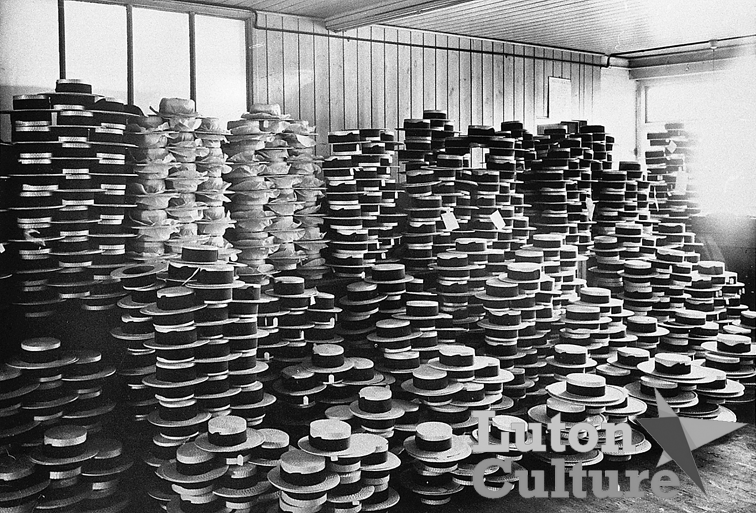 The advertising columns of The Luton News are crowded with requests for skilled machinists and operatives. The work on which they will be engaged is chiefly for the home market. There will be this season no competition from Berlin and very little from Paris. Other countries, however, are preparing to flood us with woven hats. Madagascar, South America, Italy and other countries have their agents here, who spare no efforts to effect important sales of te large stocks that are either in this country or in a state of transit more or less rapid.
If one may judge by the orders already received, as to the class of hats that will take the lead this season, they will be low-priced tagal hats - tagals certainly, and for the lowest grades plain tagals and for the higher picot tagals.
During January there has been a considerable amount of agitation, owing to the uncertain delivery of materials from Japan, Hundreds of thousands of pieces have been despatched from that country which have been inordinately delayed in transit. First the Emden raids sent the freight-steamers into the security of ports, then on reaching the London docks the exigencies of the military situation delayed for weeks the unloading of cargoes.
The local Chamber of Commerce, and firms directly interested in the matter, brought pressure to bear on the authorities, and by the third week in the month the situation was relieved, and relatively small consignments of pedal tagal reached the market. The importers fear these delays will cause such an accumulation at the docks that when it is delivered in bulk the quantity will be more than the trade can readily absorb, and prices will consequently have a downward tendency.
Something analogous has happened in regard to plain tagal, known also as thirteen-three. Last year certain Paris houses placed their orders for this material in anticipation of the requirements for the current season. But as most of their factories are now closed and the operatives in the army, they had no use for it. It was therefore sent to this country and, thanks mainly to our insular position and the effective protection of the Navy, it was readily purchased by our local firms, and as the prices were under the usual market quotations, Luton houses were enabled to turn out well-made, low-priced hats which are certainly being ordered in large quantities.
The shipping trade for straw hats is just now below the normal. Velvets and silk combinations are more in demand than straws for the South African and Australian markets. During January it has been customary to receive good orders for straws from Canada. Orders certainly arrive, but the quantities are disappointing. Possibly higher freights and increased cost of maritime insurance are important factors in the situation.
During the early weeks of the year, the City houses sent out their travellers, who traverse this country in every direction in search of customers for the goods they desire to sell. So far the orders of cheap lines are incomparably in excess of those for the best grades. Doubtless the economic condition of the country is the cause for this, as the increased cost of living and the doubling of the income tax will tend to the exercise of economy. A high price hat is a luxury, but a hat of some kind is a necessity.
One hears of exceptionally large orders being placed for men's hats. There have been recently complaints of slack trade in this section of the local industry. It is an important trade, and we hope a busy season in imminent.
Styles for ladies' hats become more varied than ever. Their name is legion, and they vary from close-fitting, compactly-made hats to comparatively large open brims. As the season advances, larger hats will be in increasing demand, but the size will be moderate and in no way comparable to the enormous productions of three seasons ago. The opinion is prevalent that the season will be a very trying one. The war cloud is still dark on the horizon, with no present prospect of its dissipation.
All the energy, skill, business capacity and commercial integrity possessed by the community will be needed and, although the economic conditions are unprecedented (unless compared with the Napoleonic era), there is no doubt that the local houses will win through and maintain unimpaired their usual position in the world of commerce.
[Source: The Luton News, January 28th, 1915]