

Stories from The Luton News, Thursday, January 28th, 1915.
The newly restored Someries Chapel at Luton Parish Church was dedicated by the Bishop of St Albans on Sunday morning in the presence of a congregation which filled the old church.
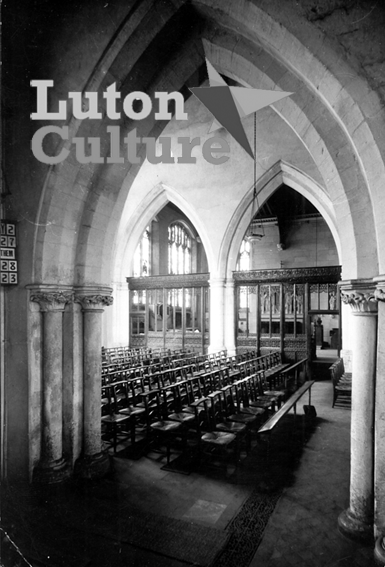 The restoration work had been carried out for Lady Wernher, of Luton Hoo, as a memorial to the late Sir Julius Wernher, Bart. The chapel had been closed while the restoration work had been carried out but "the result in its excellence must be a gratifying surprise to all who have affection for the old church". A tablet on the north wall records the purpose for which the work of restoration has been carried out.
Removal of the organ, which had had serious defects since 1911, and its rebuilding in the Hoo Chapel on the other side of the chancel had allowed the consequent opening of the beautiful Wenlock Screen.
The Someries Chapel, built by Lord Wenlock in 1461, had been given a new oaken roof , although about a dozen old tie beans had been restored, bolted together and used as one beam in the centre of the roof. A new oak Holy Table had been provided for which Lady Wernher had presented a silver cross and vases.
Three new stained glass windows had been included, incorporating some old and practically priceless glass that had originally been part of the Wenlock memorial window that was previously removed for an enlargement of the chapel and repositioning of the vestry.
-
Practical and experimental work was proposed to be included for the automobile class in the 1915-16 prospectus at Luton Modern School, Park Square. The Prospectus Committee felt it would be difficult to introduce the idea in the current school session.
-
A Belgian married couple who had been lodged for some time in one of the cottages of Lady Leon's Bletchley estate have now moved to Luton with their five children. The man has secured work in the Diamond Iron Foundry, and a cottage has been furnished her for them by Lady Leon.
-
The New Hudson Cycle Co Ltd, Luton, has produced a roll of honour of their employees engaged in the services of their country. A copy has been sent to the dependants of each man.
-
The Luton News came to the rescue of a party of 15 men and two NCOs of the 5th Lincolns who returned from 48 hours leave to find their was no connection to Luton from Hitchin at 10 o'clock on Sunday night. He arranged for a brake to drive them to Luton in time to report at headquarters by midnight. The men had left Luton at 5 pm on Friday to travel to either Grimsby or Gainsborough but did not reach their destinations until 9 am on Saturday. They began the return journey at 4 o'clock on Sunday afternoon and all went well until they reached Hitchin.
-
The Rev Charles Evelyn Charlesworth told his new congregation at Wellington Street Baptist Church, Luton, that he would accept their invitation to take up his duties as their pastor at Easter. Mr Charlesworth had been a pastor at Hastings for the past 10 years.
-
Infectious diseases were declining in areas around Luton. Rural District Council Medical Officer of Health Dr Rollings reported that specific cases involving overcrowding at Sundon had been investigated. Otherwise, there had been comparatively few cases of diphtheria in the district.
-
Owners and occupiers of properties in Cumberland Road [Compton Avenue], Leagrave, sent a petition to Luton Rural District Council urging the council to take over and make up the road. The council decided that the written consent of all the owners should be given, but three people were of the opinion that making up the road would not be much benefit to them.
-
A verdict of accidental death was returned by an inquest jury at St Albans on signal fitter Ernest Battams, originally from Luton, who was knocked down on the Midland Railway on Friday while clearing snow from points. Mr Battams, aged 40, had worked for the railway company for 20 years. He died in St Albans Hospital later the same day.
-
About 10 yards of high wall collapsed on to a women in South Road on her way to choir practice. She was given first aid before being transferred to the Bute Hospital, where she received treatment for wounds about the face and hands.
-
Based on a letter found in a dead man's pocket, the chaplain of No 8 Clearing Hospital at Calais seems to have made a mistake in identity when he wrote to Mrs Boon, of 28 St Ann's Road, Luton, informing her that her teenage soldier son had died there of wounds sustained at the front and had been buried in the little cemetery at Bailleul on January 11th. Records now show that Pte William James Boon, 3/7361, C Company, 2nd Battalion Beds Regt, was in fact killed in action about four months later, at Festubert on May 17th, 1915.