

Light emitted from factories and street lamps in the event of an air raid was the concern at a conference attended by town councillors and representatives of Luton's electricity and gas undertakings and large factories on Friday, January 31st, 1915. And the public was urged not to be alarmed if the lights did go out.
Reporting to the Town Council later, Alderman E. Oakley said some of the large works in the town, such as Vauxhall Motors and Commercial Cars, had large top lights and had to work throughout the night. Representatives of the firms had pointed out the difficulties of doing away with their lights.
 It was suggested at the conference that there might be some means of stopping the upward light, by dark canvas under the glass, but it was said this would be very costly having regard to the thousands of feet of glass which would have to be covered at some of the works.
A representative from Vauxhall works, however, said they would try to effect what was required by putting shades over their lamps, so that the light would not go upwards.
With regard to the light and power undertakings, Alderman Oakley said the Electrical Engineer pointed out the difficulty of turning off the electric light instantly, because there was risk of damage to the machinery, while the steam and vapour which would rise would be so great that it would make the place a splendid target for aircraft. It was said, however, that 30 or 45 minutes notice could be given so that the fires could be drawn, the light might be turned down.
As to the gas supply, Mr Phillips showed the impracticability of turning off the supply at the works, and said the remedy would be a great deal worse than the disease. As an instance, it was mentioned that someone might be sleeping in a room where there was a gas fire. This fire would go out, and then if it proved to be a false alarm and the supply was turned on again, the occupant of the house would be asphyxiated while in other places there would be risks of explosions and other difficulties.
The lighting of the streets was in the hands of the Town Council's Highways Committee, and if if was found desirable steps would be taken to reduce the lights.
Alderman Oakley said the matter was brought forward so that the public should not be alarmed if anything did happen. It was desirable some notice should be given, but if the town was put in total darkness people must not be alarmed.
The matter would be followed up by the Highways Committee, and if any order was received from headquarters it would be attended to at once.
[Source: The Luton News. Thursday, February 4th, 1915]
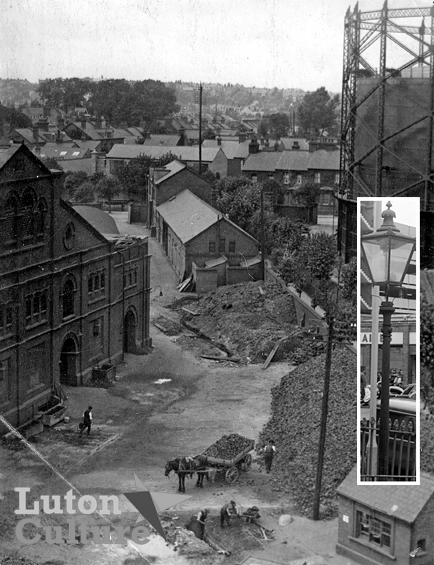
[Pictured is the rear of Luton Gas Works, Dunstable Road, in June 1921. With the Electricity Works it had provided light and power throughout World War 1. Inset is an old gas lamp still standing in Pikes Close, off Chapel Street, in 1966.]