

Unfortunately, one cannot record that there has been any material improvement in the condition of the boater trade since the last report was issued, wrote the local correspondent of the Hatters Gazette.
On all hands, from every manufacturer in St Albans and Luton, one hears the same uninspiring message that trade conditions are very, very flat. That although there are some decent orders about for various destinations, one hesitates very much to take up too great a quantity for export, owing to the extremely difficult financial situation. The writer came across one firm which had received export orders for several thousand dozens that it dare not touch for the reasons given above, and as the home trade is by no means active the position all round is very awkward.
 Of course, as far as the home trade is concerned, the abstraction from the various centres of life getting on for three million potential wearers of straw boaters, or, in fact, of any civilian headwear, must make a tremendous hole in the possibilities of supply.
The machinists who make boaters are not very great sufferers by the slackness of trade, because just now the ladies' section is so full up that, if they choose, all the hands could find plenty of work. It would, of course, for a few days be exceedingly strange after sewing rustic half an inch in width to have machine plaits little more than an eighth, but it is soon got over, and in some cases to the writer's knowledge the machinists who for years have sewn boaters, and boaters only, have turned out most capable and efficient sewers of ladies' fine straw hats.
And all that army of machine sewers that do their work at home, mainly married women, are doing very well while the military are still quartered in the district. Soldiers being billeted on them, they take decent money for their trouble, and, of course, having to "do" for Tommy takes up all their spare time, and consequently they return their machines to the manufacturers, who, as far as the ladies' trade is concerned, are now considerably affected by this stoppage of supply.
Bleachers are very busy on white goods of all natures, although one learns that the trade for export is far below the average, but while there is not the real bulk of rustic being bleached for the manufacture of boaters, there happens to be a tremendous demand for white for ladies' hats. This demand extends over all the variety of plaits now being used for fashionable wear, and includes hundreds of thousands of woven hats, such as Panamas, Curacoas, Boercus, Pandans and the like.
These are in great demand, and as the process involved in their bleaching is a lengthy and arduous one, bleachers are kept at full stretch with their somewhat depleted staffs. A tour round the bleach works brings out most vividly the immense strides made in the bleaching of grass or straw fibres during the past few years, and although bleachers are considerably hampered by the difficulties consequent on the shortage of bleaching chemicals, with the aid of British manufacturers they are enable to get along in a somewhat halting manner.
The boaters trade shows no novelty of design. Crowns and brims are pretty much as they were, different markets taking somewhat different dimensions. The bulk lines are 2¾ to 3¼ in height of crown, and from 2¼ to 3 inches wide in brim, but the majority, perhaps, run 2¾ inches.
It is entirely in the hands of the buyer, who, knowing his clientele, has to purchase for the special localities, and some districts like dimensions different to others, so that the favoured article in, say, Yorkshire might be almost out of the range of sale in Lancashire, and there fore the slightly different dimensions have to be made.
There is nothing new about trimmings except that ribbons are still on the narrow side, and from all portents are likely so to remain. The method of finish is on the neatest lines, and as little material is used as possible.
The head linings continue to be one or the other of many kinds of leathers, from plain drummed to either of the pneumatic varieties. These now present the maximum of comfort to the wearer, and have been so made as to ensure the greatest smartness of effect. Although foreign supplies have been curtailed to a great extent, our purveyors have been able to keep the market supplied and, at present, at all events, there is little evidence of shortage. Should the worst come to the worst there is always the first head lining to fall back on, but this has so many drawbacks that it is to be fervently hoped that such necessity will not arise.
[The Luton News, April 8th, 1915]
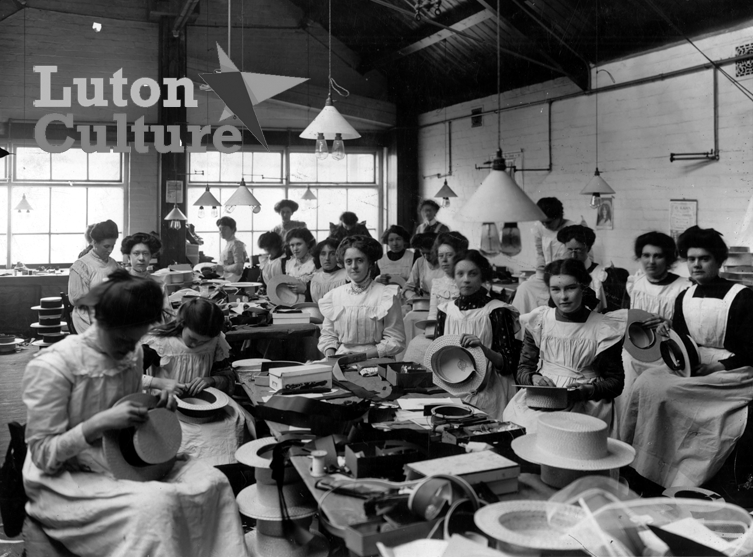
[Picture: Boater trimmers at Burley c1911]