

Eligible young men were escaping military service by going to munition works, claimed Acting Medical Officer of Health Dr Horace Sworder at a meeting of the South Beds Recruiting Committee on October 21st, 1915. He said it was well known that a number of young fellows had taken up munition work in order to escape enlisting. Was it possible, he asked, to get hold of these young men and enlist them?
Committee member Mr G. E. M. Walker said the extent to which unskilled men of military age, most of them unmarried, were flocking to munition work was almost an open scandal. There were, he continued, flagrant cases of men who were obviously doing it to escape liability for military service.
There were several cases where men had said: "Why should I enlist when so-and-so, who does not know anything about munition work, has gone to munition works, and is quite safe?" It was evident that men who were prepared to take that view would not enlist, but at the last moment, is they saw signs of strong measures, would flock to munition works and escape in that way.
It was very serious because, while there was this rapidly-growing handicap to recruiting, there was the very serious question of the supply of labour for munitions. He thought it was a matter to which the attention of the employers should be drawn at once.
Mr Walker moved the following resolution: "That in the opinion of this meeting the extent to which unskilled men of military age are securing employment on munition works is a serious hindrance to recruiting, in that not only are these men lost to His Majesty's Forces, but their example deters others from enlisting, and steps should be taken to insure that no such men be engaged in this way in future, unless they can produce their certificate of of rejection, or unless there is a proved shortage of unskilled labour in any recruiting area."
He said this was not a matter which reflected in the least on firms engaged in munition work.
Lieut-Col Fenwick seconded, and added that one trouble experienced by recruiters in the villages was that the men moved into Luton to work at the dye works.
Employer Mr Henry Davis [Diamond Foundry] said he had no wish to oppose the resolution but at the same time he must express a good deal of surprise at the statement which had been made. He happened to represent a firm engaged on munitions, and one of their great difficulties was obtaining youthful labour. Their difficulty was to obtain men of that kind whom they could train for munition work, and not only to engage such men for unskilled work but also for semi-skilled work. Older men were not so pliable to pick up a trade as younger men.
If the statement made was true, the resolution was a right one, but the question was whether it would not prevent firms obtaining men under the conditions he had stated. After all, is such men were engaged they were naturally wanted, and he suggested it be left to the patriotism of the employers.
He would never think of accepting men of military age for unskilled work, but he would welcome young men of 17 or 18 whom they could train to more or less skilled work. Possibly such a resolution as this might be dangerous in preventing firms obtaining men under the conditions he had stated.
The Mayor (Councillor Walter Primett) said they were indebted to some of the firms for absorbing labour which might otherwise have been unemployed. The employers had given the Recruiting Committee every assistance, and had allowed meetings to be held at the works and the men to be canvassed. When war broke out 30 per cent of their employees left for the Colours, so no-one could throw a stone at their patriotism. That was not intended at all, but they did know most definitely that recently single young men had gone into the works to escape enlistment.
Mr Davis suggested that the matter might be met by writing a letter to each employer, poitning out that the committee had found that men of military age were applying to works for employment with a view to being exempt from military service, and asking them to keep a careful watch and endeavour to prevent any men of military age being employed in any form of unskilled work.
The original resolution was withdrawn.
[The Luton News: Thursday, October 28th, 1915]
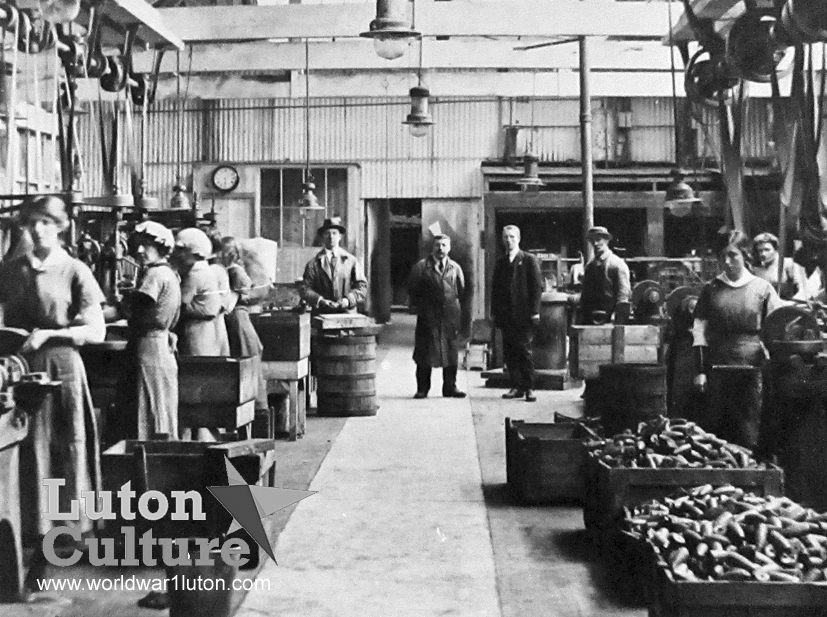
Pictured above is the Diamond Foundry when women were the prominent workforce.