

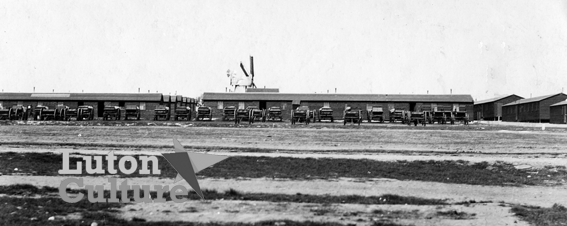
A baby girl was discovered on Saturday evening [November 20th, 1915] in one of the huts belonging to the Biscot Mill Camp of the Artillery School. It was the subject of what the Luton Reporter described as a very amusing story that was going the round of the soldiers quartered there in regard to the discovery. However, it was not anticipated that there would be a tragic ending to the story.
The baby turns out to belong to a Luton mother, said the newspaper, and the explanation for its removal to the soldiers' quarters is furnished by a raw recruit. His story appears to be that as he was passing down New Street he heard the cries of a child coming from a cottage and, as nothing appeared to be done to pacify the youngster, he took the liberty of opening the door and entering the house.
He found the baby lying in a cradle with no one in attendance, and as he could not bear to hear the child's cries, he took it out of the cradle, wrapped it in something warm that lay handy, unbuttoned his coat, tucked the baby underneath, and walked off out of the house with it!
Nearby he came across a bicycle standing in the street unattended, and this he mounted and rode off to the huts with the baby, which he deposited in the bed of one of his comrades. When left alone the child set up another cry, and naturally attracted attention. Among those brought on the scene was the occupant of the bed in which the child had been placed. He was not exactly delighted with the present which had been made him, and he passed the child on to someone else.
The someone else took up the same attitude, and so the child was being continually passed on until the arrival on the scene of an orderly corporal, whose inquiries resulted in the story of the baby's arrival at the huts being told.
The recruit responsible was straight away ordered to return the child to its home, and the next morning he also took the borrowed bicycle to the police station. How he fares as a result of his soft-hearted intervention is not related, but the mother was overjoyed when she received the child back for when on her arrival home she found the cradle empty, she at once proceeded to the police station and reported her loss.
But it was at an inquest on November 30th that the full story was to be revealed. The child, identified as Phyllis Maud Selina Waterworth, aged 12 months, died on November 27th, but from natural causes and not as a result of what had happened a week earlier, a jury decided. She was the daughter of Pte Albert George Waterworth, 1/5th Bedfords serving in the Dardanelles, and Nellie Selina Waterworth, of 3 New Street, Luton.
The soldier who took the baby to Biscot Camp was identified as Driver George Mackie, a single man serving with the 3/4th Northumberland R.F.A. He had previously met the mother at the Queen's Head public house in Chapel Street on several occasions. He had entered her unoccupied house to attempt to appease the crying baby, before taking the child to Biscot Camp to keep her warm.
On the following Tuesday [November 23rd] the child was at home and not well and a doctor was called. She died the following Saturday, apparently from natural causes.
Mrs Waterworth had four children, the oldest aged eight. The baby was described as a delicate child who had been attended by a doctor in October. After reporting the child missing, she went home to find the baby returned, seemingly half-dead and cold. The baby was given warm milk and slept through the night, but next day seemed to have caught a chill.
The mother said she had left the house with the door unlocked while she went to the market to buy fish. Police evidence said she was a known frequenter of certain public houses.
Returning a verdict of death from natural causes, in accordance with the medical evidence, the jury advised the censuring of Mrs Waterman for leaving her children unattended at home and neglecting them.
Coroner Mr G. J. M. Whyley said the mother must he heartily ashamed of herself. She had brought herself into what might be a very serious position, and she might congratulate herself on getting off so lightly. She had three other children, and he advised her to stop at home and look after them.
[Luton Reporter: Monday, November 22nd, 1915; Luton News: Thursday, December 2nd, 1915]