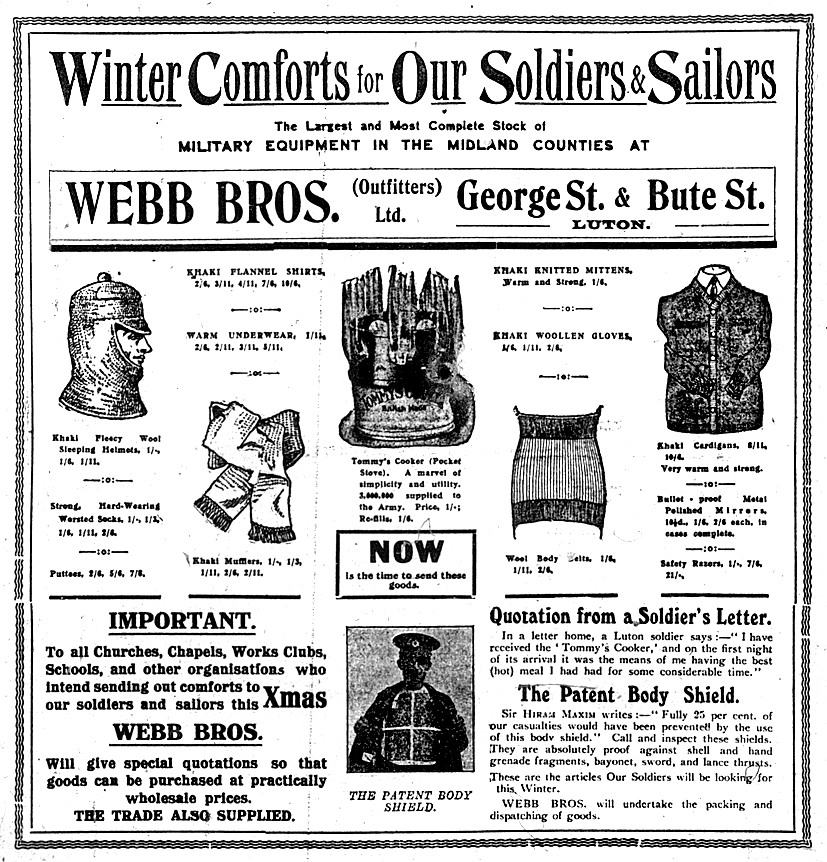
Advert from December 1915
Stories from the Luton News: Thursday, December 16th, 1915.
A Luton mother, whose baby was taken to Biscot Camp by a soldier who found it crying and unattended at home and was later censured at an inquest after the baby died a week later, was sentenced to two months hard labour in prison for child neglect on Tuesday [December 14th, 1915] after she had moved from Luton to Dunstable.
Nellie Selina Waterworth, wife of a soldier serving in Gallipoli with the 1/5th Bedfords, had escaped punishment other than censure when an inquest jury decided that baby Phyllis Maud Selina Waterworth, aged 12 months, had died from natural causes.
Neighbours and visitors to her new home in Manchester Place, Dunstable, began reporting concerns when her three other children - Bert aged 8, Doris 5 and James 3 - were seen insufficiently clad and with no footwear, sitting in a cold room without a fire, and crying outside while their mother was away, some times in pubs with soldiers. Mrs Waterworth had previously lived at 3 New Street, Luton.
Sentencing her, Mayor F. T. Garrett said the Dunstable Bench looked upon this as one of the worst cases they had had before them. Defendant was not only a disgrace to her sex, but to humanity. She had not the affection for her children that an animal had, and they were bound to take into consideration her past character and all that had occurred.
They would not do justice to the children unless they removed them from her custody. The children would be removed to the Children's Home at Luton to be taken care of, and they hoped that when she came out of prison their mother would reform. The Mayor thanked those people who had brought the case to the notice of the police.
-
A terrible tragedy occurred on Tuesday at the bleaching and dyeing works of Mr Hubbard in Regent Street, Luton, involving the death of George Allen, aged 25, a native of Barton lodging with his brother at 13 St Saviour's Crescent, Luton. He was lifting plait out of a vat full of boiling liquid when he overreached and fell in, greatly to the horror of his workmates. He managed to scramble out and was taken to the Bute Hospital, where he died at 5.30 the same evening.
-
News has just been received of the death of Pte Arthur Woodcroft, killed in action in France at the end of November. He was 28 years of age, and before enlistment worked at Mr Hubbard's dyeworks in Regent Street. He lived at 66 May Street, Luton.
-
Two men at Luton were sufficiently dilatory to be excluded from attestation under Lord Derby's scheme, even though to the original week's extension another day was added. They turned up just as midnight struck on Sunday, and were too late. Now they can only show their willingness to place their services at the disposal of the country by enlisting straight away into some unit. By their delay they lose the advantage of being placed in a group to be called up at a later date, and also their right to appeal to be placed in a later group.
-
Miss Mildred Brown, one of the V.A.D. nurses at Wardown, saved the life of James Wonmer, a middle-aged man living in Clifton Road, by rendering first aid after he collapsed in Lyndhurst Road on Saturday afternoon. Mr Wonmer was taken unconscious to the Bute Hospital, where he had recovered by Wednesday evening. He had been ill for some time.
-
Lieut Nelson Johnstone, 2/2nd Midland Brigade Field Ambulance, R.A.M.C., who was at one time a doctor at the Luton Medical Institute and was later in private practice in Luton, died suddenly at the age of 41 at Cambridge while undergoing an operation at a military hospital. Dr Johnstone, who was stationed at Kings Lynn, was one of the doctors who attended men shot in the Siege of Sidney Street in London in January 1911 and was himself shot in the head. In 1915 his second wife Edith was living at 6 Union Street, Luton, from where Dr Johnstone had set up a private medical practice.
-
Sapper Harry Proudfoot, Royal Engineers, of 58 Butlin Road, Luton, has been wounded a second time. He was first in hospital in France having been wounded in the face and shoulder, and then received a serious wound in the eye and was in hospital again, at Boulogne. He had attended Christ Church School.
-
A number of Stopsley lads who had been on active service were now in hospital. They included George Webb in France, Fred Goodship in Reading Hospital, Charles Burkett in France, Albert Smith in Mustapha, Egypt, and Arthur Smith in hospital at Cardiff.
-
The 140 men of various bodies connected with King Street Congregational Church and serving with the Forces in Gallipoli and France had been sent Christmas parcels containing woollen garments, sweets, tobacco, cigarettes etc.
-
The Luton Prisoners of War Fund continues to send fortnightly parcels to the Lutonians who are prisoners of war. In addition to the ordinary parcels, the committee have sent a special Christmas parcel containing a Christmas pudding in a tin, a cake, a tin each of fish and meat paste, tea, treacle, plain chocolate, toffee, margarine, bacon, dates and cigarettes.
-
Mr W. B. Munns, of Tennyson Road, Luton, who provided an interesting exhibit of a complete collection British butterflies for display in the Public Library, has added a case containing a variety of beautiful moths.
-
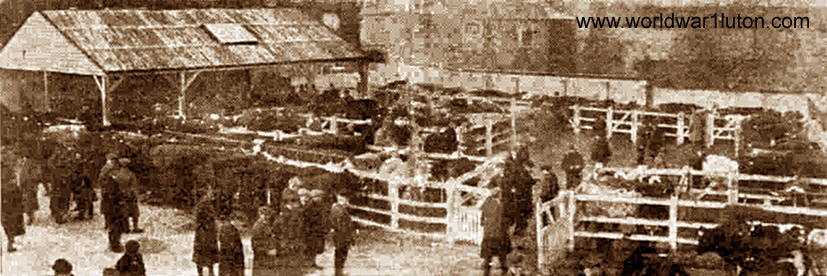
The 51st annual Christmas fat stock sale (see picture below) held by Messrs J. Cumberland and Son at their Luton saleyard [in Bridge Street] on Monday set a new record, topping the record of the previous year's jubilee sale. On offer there were 204 heavy oxen and heifers, eight calves, 388 fat sheep, 138 fat pigs, porkers and bacon hogs, and an average supply of poultry. There was a large attendance of buyers, and for beef and pork trade was extremely good, but mutton was rather slow.