

From the routine of the Luton Municipal Offices to Moscow and a thrilling life with the Russian forces is surely sensational change enough for the most adventurous. To be well know in local scholastic circles and as a motor-cyclist is one thing; to be showered with flowers, banqueted, presented with an ikon of Michael of Archangel and entertained in the Summer Garden is quite a different story, and one which is calculated to make the young British blood of fellow townsmen, whether educationalists or motor-cyclists, tingle in their veins.
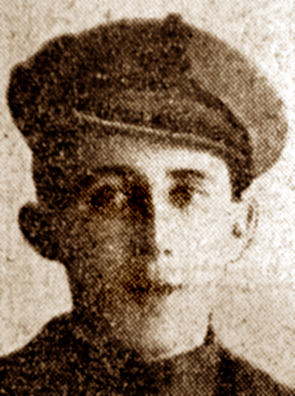 Yet this has been the kaleidoscopic experience of Petty Officer Robert R. C. Starke (pictured right), Royal Naval Air Service, of Park Street, Luton. This young and gallant Britisher is only 25 years of age, and was fortunate enough, along with Petty Officer Harry C. Sell, the son of Luton's school attendance officer, to secure enlistment in that branch of naval air service before the doors were shut against all comers.
Now these two brave fellows are members of the "complete and fully-armed British unit" whose arrival at Archangel was so joyously announced in Tuesday's papers. This unit has been accorded a great reception in Russia. After marching through the town they were met by the military, educational and civil authorities, and the officers of the municipality.
They were each presented by the latter with an ikon of Michael of Archangel, were entertained in the Summer Garden, and the whole town was decorated with flags and was en fete.
At Moscow the British naval armoured car detachment (in which Petty Officer Starke is now a driver) met with a most enthusiastic reception. The commander of the troops in the Moscow district was at the station, and the crews and bans of a Russian armoured car detachment were on the platform, while outside the station great crowds, numbering thousands of people, waited to give their British Allies a hearty welcome.
From the station the men marched through the city, headed by a Russian band, to see the English church, where a short service was held. They were warmly cheered and were pelted with flowers as they passed. They were afterwards entertained to lunch at the British Club, many Russian guests being also invited.
Cordial toasts were exchanged, the speakers dwelling especially on the moral significance of the fact that Russians and British would shortly be fighting shoulder to shoulder.
The Grand Duchess Elizabeth received Commander Locker-Lampson and several other members of the detachment, and presented mementoes to all the officers and men. Elsewhere on their journey through Russia the welcome extended to the detachment was no less hearty than their reception here.
Every station was beflagged in their honour and filled with cheering, hand-shaking throngs, including the local school children and Boy Scouts, who threw flowers, cigarettes and other gifts into the carriages. With every train they passed, too, whether military or ordinary, hearty greetings were exchanged. The detachment is proceeding forthwith to the headquarters of its future service. Commander Locker-Lampson has started for the Front.
There was a remarkable scene during the performance in the Moscow Arts Theatre at which Major Mairis and the other officers of the Armoured Car Detachment were present. The appearance of the Britishers in the auditorium was greeted with salvos of cheering, which lasted over five minutes. The actors invited the British party on to the stage, and cheering could be heard from behind the curtain. The public demanded the raising of the curtain, and when their request was complied with, there was one great demonstration in which both actors and public joined. Major Mairis, on behalf of himself and his fellow officers, expressed his warmest thanks for this demonstration.
 During a march of the force through the town a Cossack squadron escorted the British detachment. A Cossack officer dismounted and offered his horse to Major Mairis, who mounted amind great cheering.
The detachment left in the evening, crowds cheering it all the way to the station, while bands played and flowers were showered upon the visitors.
Petty Officer Robert Starke joined on November 18th, 1915, and, along with his comrade Mr Sell, has experienced five months on the ice. As stated, he is one of the drivers of the 60 armoured cars for service with the Russian Army, and is not on his way to the Russian front.
He and Mr Sell must often reflect on the complete change in their lives since they were together at the Luton Town Hall. They sailed for Russia on December 2nd and were liberated from the ice on May 14th.
Mr Starke was assistant to Mr Carter, Secretary of the Education Authority, and was well known in the town. His father is receiving congratulations on all hands, and may be excused a pardonable pride in his son's patriotic progress, while the petty officer's many scholastic and athletic friends will read with delight of his eventful happenings.
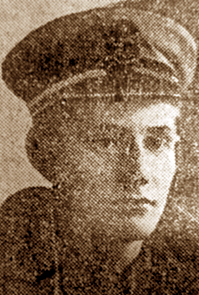
Petty Officer Harry C. Sell (pictured right, below) is the son of Mr and Mrs H. L. Sell, of Kempton Villa, Cromwell Road, and was in the Town Clerk's office priory to enlistment on November 18th.
[The Luton News: Thursday, June 22nd, 1916]