

Digest of stories from the Beds & Herts Saturday Telegraph: January 5th, 1918.

Tomorrow will probably be a meat-less day for many in Luton, as this morning saw the butchers' slabs clean and bare and, in many cases, their windows shuttered.
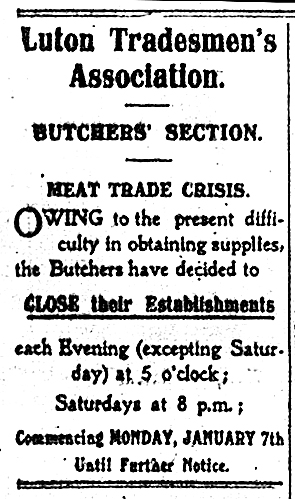 The prophecy made at Thursday evening's meeting of the Luton Food Control Committee by Councillor Attwood with regard to meat queues has been fulfilled, for this morning three members of the Police Force were engaged in regulating one outside a prominent butcher's shop on the Market Hill.
A shop nearby had nothing to offer but corned beef; at another all the meat had been previously ordered. In fact practically every shop was either closed down or had no meat for casual - if even for regular - customers.
"Sold out" was the information given hundreds of times during the morning by almost every butcher in the borough, and on the locked door of one we noticed the legend, "Sold out. No further supplies".
One butcher said that, although he had no meat for sale, he intended to keep open all day so that his customers could call in for the meat they had ordered. He explained that he had kept back a little meat during the week so that he could let customers have as much of their usual weekend amount as possible. He further informed us that he had not even enough left for his own Sunday dinner.
"Not a ha-porth," was the reply of Mr H. Clarke, Chairman of the Butchers' Section of the Tradesmen's Association, to our query as to the amount of meat he had for disposal. He added that as soon as he had cleaned up the shop he was going to shut it, and further told us that he had this morning information from a reliable authority that there was no prospect of improvement during the next week or two.
During the last few months Luton had been better supplied than most towns, but the position had now become very serious. At the cattle market on Monday there were only 13 head to be divided among the butchers, whereas the average was over 100.
Finding butchers' shops in a state similar to that of Mother Hubbard's cupboard, the public seem to be turning to their fishmongers, and we noticed the shop of one filled to overflowing and, though there was generally a fair supply, it looked probable that before closing time it would prove unequal to the demand.
-
For some time we have been aware of movements in the Luton Trades and Labour Council for the promotion of a candidature for this Parliamentary division. At the request of certain officials of the party we have refrained from the publication of an indefinite and uncertain proposals. We now understand, however, that the executive of the N.L.P. [National Labour Party] are pretty fully determined on contesting this seat at the next Parliamentary election. The assurance of this lies in the fact that the Luton Trades and Labour Council have been urged to proceed with the preparation and the acquirement of such machinery of organisation as may be necessary for a successful candidature. Unofficially names mentioned are Mr Willet Ball (N.U.R. and acting editor of the Railway Review), Mr William J. Mair (Iron Moulders Union), and Mr Thomas E. Knight (Scientific Instruments Makers' Society).
-
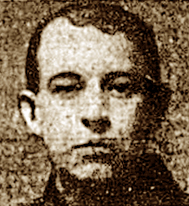 We learn that Pte 'Tommy' Samuels (Bedfordshire Regiment), whose home is at 5 Gaitskill Row and was taken prisoner soon after the commencement of hostilities, has now been transferred to Interlaken in Switzerland. The announcement appeared in a list on New Year's Day. Pte Samuels is pictured, right.
 -
The new Secretary to the Luton War Pensions Committee, in the place of Mr E. A. Mander who has resigned, was appointed last evening at a special meeting at which four applicants from an initial list of 17 were interviewed. The successful candidate is Mr Walter Lloyd Suttle, a discharged soldier, a young man who has made his home in Luton for the past eight years. Son of the Rev C. A. Suttle, of London, he enlisted in the East Anglian Royal Engineers in March 1915, but illness finally requiring an operation led to his discharge in May 1917, after two years and 80 days service. He returned to his wife in Luton and took up an appointment at the Skefko Ball-Bearing Co. Prior to the outbreak of war he had been employed by hat manufacturer Mr William Gillam.
-
George Butcher made a welcome return to the Luton Town FC forward line against a Canadian Pay Corps team on the Town Ground this afternoon. Butcher, now in khaki and unable to play regularly, undertook a 40-mile cycle ride to be in the match, two other players having five-miles walks before playing. In the end the Canadians were easily beaten 8-0 with Butcher scoring a goal in each half, the first from the penalty spot.