

The local food troubles reached a climax on Tuesday [January 29th, 1918] when the strength of the Trade Union movement in Luton was utilised for the purpose of bringing certain aspects of the matter prominently before the public and the public's representatives. Practically the whole of the men engaged in the engineering trade made holiday for the purpose of presenting themselves en masse for the benefit of the town and the Food Committee in particular at the Town Hall.
They met at 9am and, after a meeting on the Moor, they marched to the municipal headquarters. The square, if it may be called such, was crowded, and it was computed that there were at east 5,000 people present. From the Town Hall steps the case was briefly stated by Messrs J. H. Mabley and T. Knight, the latter submitting a resolution to be put to the committee. A forest of hands went up in favour of the resolution.
Mr Mabley, who organised the demonstration, then spoke, asking the crowd to remember to which class they belonged and to conduct themselves quietly and properly, and interfere with none. The deputation then met in the Mayor's Parlour, and the Food Committee in the Council Chamber as a preliminary.
When the deputation went into the Chamber, the Deputy Mayor (Alderman J. H. Staddon) was in the chair, and all members of the Food Committee were present with the exception of Alderman E. Oakley. The Chairman welcomed the deputation, and said that he had no fault to find with the action taken, but it was unfortunate that it had been necessary, in their opinion, to take this somewhat drastic step. So far as they were concerned the position would be relieved, and relieved quickly.
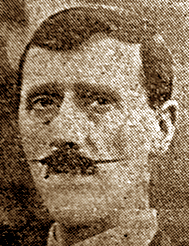 Mr W. J. Mair [pictured], as spokesman for the delegation, gave their names as follows - Mrs Goulding (National Union of Women Workers); Messrs J. H. Mabley, Brewer, White and Shaw (Toolmakers); W. J. Mair (Moulders and Ironfounders); Wood, Rowe and W. Rookwood (Amalgamated Society of Engineers); Skelton and Devey (Steam Engine Makers); Joyce (Wheelwright and Carriage Builders); Haddon (Carpenters and Joiners); and T. Smith (Secretary of the Luton Trades and Labour Council).
Mr Mair spoke carefully and deliberately, and said the resolution they were to put was drafted at a mass meeting on Sunday night. He read the resolution, which was as follows:
"We demand the reconstruction of the Luton Local Food Committee; we demand that if the present constitution of the Committee remains at 12, we shall have at least four representatives, of whom one shall be a woman; if it is decided under the new powers given by the Food Controller to extend the Committee to 15, we demand six positions on the Committee, to whom two shall be given to women. We also demand total abolition of private delivery of foodstuffs, except to nursing mothers, invalids and children."
Mr Mair then reviewed the circumstances which led to the demonstration. He pointed out that the Trades and Labour Council asked for three representatives when the Committee was formed, but in spite of protests only one was given. More protest meetings were held, and the Town Council turned down more resolutions. Then the only Labour representative was withdrawn and a demand for six representatives was ignored, proving that the municipal authorities were out of touch and sympathy with the public.
He asked if there was any member of the Food Committee who was prepared to say that he was representative of of that great body of people they had seen outside the Town Hall. He questioned it. That deputation comprised the real representatives of the people who had to work day by day, the people whose wives and children had to stand in queues and who saw goods being taken from butchers' shops to private houses while they were waiting for hours to be served.
Lord Rhondda [Food Controller] laid it down that the interests of the community should be the first consideration of the Committee. Those interests had been a secondary consideration, because the majority of members of the Town Council and the Food Committee were living in a bygone age. He had given the irreducible minimum of their demands ad he asked the Committee, having seen by the assembly outside what the force of Labour meant, if they were prepared for that force to go farther. Their demands were fair and square.
Mr Mabley endorsed what Mr Mair had said, and added that the butchers were delivering meat to certain classes in the town but not to the districts where the workers resided. The workers were determined to have their demands and decision carried out, and he was with them entirely.
Never in the history of the town had such a demonstration of Labour been seen. They represented something like 7,000 workers, and on a family basis there would not be many left out of a population of 50,000 to 55,000. The workers were disgusted with the way they had been treated as regarded food.
There were men on the Food Committee who said they had a perfect right to issue tickets to privileged customers, and to refuse to serve the dependents of men who were fighting at the Front. Was it equality? They wanted all classes to make sacrifices in the same way as men who went "over the top" at the Front, and they would not tolerate any further deliveries of meat in that district to the "upper ten".
They were prepared to take their share of the difficulties with others in the town, but he warned the Committee that the workers were now very, very strong. Women working in factories while their husbands were fighting for democracy had to leave their work to get food, while people without family could get meat delivered to them on meat-less days. He knew difficulties were in the way of the Committee, but by granting the demands of the deputation the Committee would be helping themselves, for the information could be distributed among the workshops, and there would not be a repetition of this demonstration again.
Mr Knight said they were justified in their action, and he asked if it was fair to the deputation that the whole of the Food Committee should not be present. The Chairman explained that Alderman Oakley was the only absentee, and he was in London that day because the trade of Luton and elsewhere was on the rocks.
Mr Knight accepted the information, and went on to say that the workers felt that they were not being fully safeguarded by the Committee as at present constituted. Members of the Committee had expressed the view that they represented the people. He submitted that if such had been the case they would not have witnessed such a demonstration.
They asked that the present methods of distribution should be set aside, and that the interests of the public should be of real importance to the Committee and that nursing mothers and invalids should have their wants attended to first. He proceeded to give instances of women with large families being unable to get foodstuffs and of having to stand in queues, and emphasised the remarks of Mr Mabley that the workers were prepared to share the sacrifices necessary by shortage but, like many more, he was not prepared to see his wife and children go short while others had plenty.
Mr Mabley challenged the statement by a member of the Food Committee that employees at a certain firm would strike if they did not get meat. Councillor Attwood said if he was the member referred to he would give the name of his informant - Mr Lovett, the butcher, and the firm was Skefko.
Mr Mabley did not blame Councillor Attwood but the firm who, he declared, had no authority from the men for the statement. He also referred to Councillor Yarrow's statement that the munition workers were pampered, and asked if that gentleman was aware that some of those workers were doing 100 hours a week.
Councillor Yarrow did not wish to blame the Press, but suggested that condensation of report had resulted in a full statement of what he said not being given. He was second to none in his sympathy for engineers as a class, as he knew what it was to work for long hours. He referred to the case under which the question arose, the supply of sugar to Messrs Hayward Tyler's proposed canteen, and said that if he made a mistake he was prepared to withdraw it. They had information of tea being served at dinner and in the afternoon before the workers left, and in such case he thought people who were getting a share at home and another share at work were having an undue proportion, and said there would be a further shortage for the general public.
Mr Mair emphasised the needs of the women workers, and especially the hardships of soldiers' wives at work in factories because the pension allowance was not sufficient, and girls coming from a distance who had to board themselves at their lodgings. He gave concrete cases of hardship in regard to soldiers' wives. Councillor Primett and the Town Clerk said that such cases were a matter for the Pensions Committee, and that women with large families had no business to be at work.
Mr Rookwood told of a visit to a shop in Chapel Street and the refusal of the manager to supply him or his wife with rasher bacon while serving others with half hams and rashers. He pointed out the injustice in workers whose purchasing power did not equal that of others. Then he want on to deal with the margarine question, and the frequent forfeiture of the ticket for a less quantity than that to which the customer was entitled.
In the subsequent discussion, the Executive Officer [Town Clerk Mr William Smith] pointed out the lack of foods to distribute, and the lack of real control by the Committee.
The Deputy Mayor said he felt that the action of the men was perfectly justifiable up to a certain point, but he thought the case would have been met had the deputation alone come to the Town Hall and the others remained at work. He could not rule Labour, but he did not feel inclined for Labour to rule him too much.
From the start he had not been in favour of the constitution of the Food Committee. He had no handling of it, for it was taken out of his hands, and the Council were determined to have a majority on the Committee. Whether it was wise or not, the Council were the best judges.
With the influx of the working classes, Luton had become a working class constituency. He pointed out that in the constitution of the Committee traders were to be appointed. Mr Sanders had given most valuable information and was the last man he wanted to see removed from the Committee. Labour was to be given one.
The Deputy Mayor said the Council selected the minimum. Then there was the Co-operative Society to be represented, and Mr Ball represented 22,000 members. The Committee admitted there should be a stronger representation of Labour, but he did not like the demand for the reconstruction of the Committee. An increase to 15 was not reconstruction, and the Committee were placed in an awkward position. If they said he was to go he would go, and be delighted to go.
The chairman said there had to be one lady on the Committee also. The deputation had made very definite and determined efforts to remove Alderman Oakley. He pointed out the difficulties of the firm, and that Messrs Oakley Bros, in registering their customers, had only obeyed the Government recommendation.
At his request, on Saturday the manager of the shop allowed margarine to be a free sale. He proceeded to show how in October they urged Sir Arthur Yapp [Director of Food Economy] to ration all articles of which there was a scarcity, and had failed. Then he promised that the deamnd for non-delivery should be placed before the butchers.
Speeches were made by Alderman Wilkinson, Councillors Primett, Yarrow and Attwood, Mr Sanders and Mr Ball.
Messrs Mair, Knight and Mabley replied, and pressed for a reply that night, or the men would not resume work on the morrow. They also pressed for the removal of Alderman Oakley.
The Town Clerk pointed out the impossibility of a reply that night, as the Committee had no power to appoint and the Town Council could not be called without three days' notice.
The Deputy Mayor eventually gave a guarantee that three Labour nominees should be placed on the committee in addition to Mr Ball. He said there might be two resignations - if not eight or ten. After what had been said Alderman Oakley could not possibly, and would not wish, to remain a member of the Committee and, in addition to the present Labour vacancy and Alderman Oakley's there would probably be another. He knew one that would retire at once - Mrs Staddon.
Mr Mabley said they wanted no bartering for any member to go. The Town Council had got into a knot and they should get out of it.
The Chairman repeated his guarantee, and said that if there was no other way out he would resign himself. The deputation accepted the guarantees and, thanking the Committee, withdrew.
[The Luton News: Thursday, January 31st, 1918]