

Digest of stories from the Beds & Herts Saturday Telegraph: October 19th, 1918.
The risk of sending into the services men who are not physically capable of withstanding the transition from comfortable homes to the hardship of camp life is instanced in the sad death of Pte Harold Charles Brightman, whose home is at 25a Langley Street, Luton.
A bright lad, he was 18 on August 21st, and apparently strong and hardy. He was employed by Mr S. Wingrave, hat manufacturer, Inkerman Street, until he was called to the colours on September 17th. He was sent from Bedford on September 19th.
On October 14th he passed away under circumstances which have induced Mr Wingrave to make strong representations to MP Mr Cecil Harmsworth.
Although the Medical Board placed him in Grade 2-B2, that was not because of any organic disease but owing to his eyesight, and neither parents nor son had any fault to find in that respect.
He was sent to a Midland town for training, and within a fortnight was inoculated twice. When his father went on one occasion to see him, he found him sleeping under canvas through which the frequent rains continually dripped. There were no boards on the ground, only a tarpaulin and blanket being available.
The consequence was that the young man, with a number of others, developed a chill, and pneumonia supervened. Nothing was known of the precarious state of their son by Mr and Mrs Brightman until they were summoned last Friday night. They went by the midnight train and reached the hospital the following morning. He was already delirious and only knew them at short intervals, and he passed away on Monday morning.
The information gained by Mr Brightman as to the conditions prevailing at the camp in question was passed on to Mr Harmsworth, and it is hoped that something will be done to remedy such a state of affairs.
-
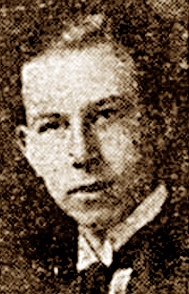 Sgt H. C. Hunt (pictured right), who has won the Distinguished Flying Medal, is now in hospital at Grosvenor Square, London, suffering from nerve strain. An old Modern School boy, his home is at 222 Beech Hill, Luton. He will take his commission as a pilot when recovered.
 -
News has reached Luton that Sec-Lieut H. E. Merchant (Royal Fusiliers), of Charlton-cum-Hardy, received multiple wounds from shell on September 27th and he is now at Streatham Hill Hospital, Exeter. Formerly a clerk at the Cocoa Works until 1917, he brought down two German machines and an observation balloon before coming home on leave in August, an a further seven Hun machines were placed to his credit on his return to France.
-
Today being 'Our Day' Luton is doing its best to help the British Red Cross and the Order of St John of Jerusalem both by the sale of flags and other emblems in the streets, and by various other methods. The amount at which the Mayor, Councillor Charles Dillingham, is aiming is £2,500, and this morning Mr Dillingham informed us that everything was going along most satisfactorily, and that his anticipations would certainly be exceeded.
-
We all know that there is such a thing as overworking a willing horse, and it seems that it is equally possible to put too much strain on a railway locomotive. Proof of this was brought home in a very unpleasant manner to the passengers by the 12.20 train from Luton to Dunstable on Saturday. The train was very crowded, notwithstanding that an extra number of coaches had been added, and the consequence was that upon arrival at Chaul End the engine was unable to negotiate the incline, and an additional engine had to be obtained from Luton before the train could proceed. The result was that Church Street was not reached until 1.20, and there is only a single line, passengers from Dunstable had to fume and fret at similar delay The 1.05 from Luton also took about three-quarters of an hour to do the four or five miles.