Mr William Sewell, who is employed at the Great Northern Railway Station, Luton, as a signalman, sends us an interesting account sent home by Sapper Alec [Alexander] Johnson, who was a platelayer here with the GNR before joining the Railway Operative Workers' Corps, with which he has been serving in the East.
He is the husband of Mrs Nellie Johnson of 32 Cobden Street, Luton, to whom Sapper Johnson wrote the letter, with the request that it should be forwarded to his friends at the station.
Digest of stories from the Beds & Herts Saturday Telegraph: February 23rd, 1918.
We are pleased to learn that Sec-Lieut Samuel Deller, of 147 Wellington Street, Luton, has recently been promoted to the rank of Captain, the honour being conferred after a dashing exploit during the fighting in France.
Luton War Pensions Committee were unanimous at a meeting on Friday (February 22nd, 1918) in supporting a resolution from Bradford urging the Government to see that greater care is exercised in the medical examination of recruits for the forces, on the ground that experience of dealing with discharged disabled soldiers has shown that many men who were physically unfit have been taken into the Army, and after very short service have become a charge upon the Ministry of Pensions.
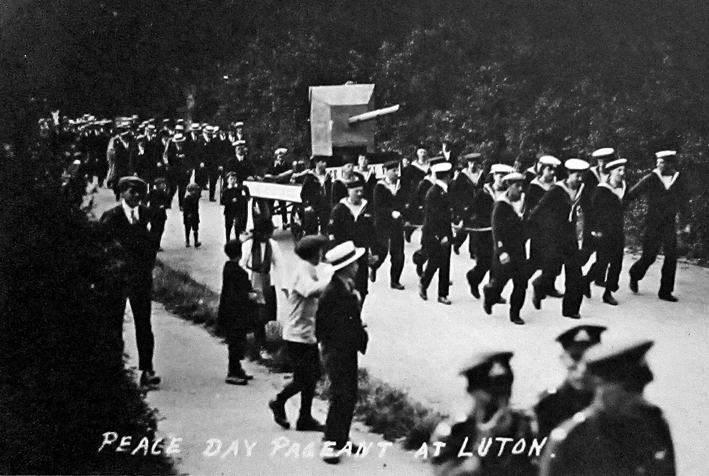
Mayor Henry Impey reading the King's proclamation on Peace Day.
It was not until ten years after the riotous events in Luton on Peace Day that 1919 Chief Constable, Charles Griffin, revealed some added details of how Mayor Henry Impey was got away from the blazing Town Hall, and how an attack aimed at also burning down the police station was thwarted.
Digest of stories from The Luton News: Thursday, February 21st, 1918.
Leagrave in 1906
A remarkable situation has arisen at Leagrave whereby tenants of long standing have had notices to leave their homes. The matter was brought before the Luton Rural District Council on Monday.
His Honour Judge Wheeler was very sympathetic at Luton County Court on Thursday [February 14th, 1918] towards an 18-year-old munition worker names Olive Eva Burton, of 34 Melson Street, who met with an accident while in the employ of Messrs George Kent Ltd on December 8th which resulted in her losing the sight of one eye and being in danger for some time of losing the sight of the other.
"I hope that calamity is spared her," said the Judge, and Mr H. W. Lathom, who appeared for the applicant, was glad to assure His Honour that this was so.
Digest of stories from The Luton News: Thursday, February 14th, 1918.
The feeding of under-fed children at Luton schools and the evil of children standing in food queues were two of the chief subjects of discussion at the meeting of the Luton Education Committee on Tuesday evening.
[The Luton Reporter: Tuesday, February 12th, 1918]
Last night Labour's three new representatives made their first appearance at the Luton Food Committee, and they made things so warm that at the end of the two and a quarter hours sitting the Committee adjourned with not much more than half the agenda dealt with.
Digest of stories from The Luton News: Thursday, February 2nd, 1918.
Yesterday, the gratifying report was made at the annual licensing meeting for Luton borough that last year's total was the lowest on record for drunkenness.
[From The Luton News: Thursday, February 7th, 1918]
In the history of the Luton Corporation the Town Council have never been confronted with such a problem as on Tuesday night. The events of the last ten days became centralised. It was the most nervous meeting of the Council in recent years. There was mercury in the air when the Council met, and it remained for three hours.
Our readers are fully conversant with the demonstration of last week, and the position then amounted to this:
Digest of stories from the Beds & Herts Saturday Telegraph: February 2nd, 1918.
We should imagine that many of the demonstrators in Luton on Tuesday have now come to the conclusion that they gained a Pyrrhic victory, for they secured what they asked but lost their dinners, or a very considerable portion of them.
"No deliveries of meat except to nursing mothers and invalids," they cried, and we agree they cried justly. The butchers agreed to no deliveries, and as a result no meat went to munition works [where most of the demonstrators were employed].