L-Cpl B. J. Douglas, 2nd Battalion Essex Regt, is in Shrewsbury military hospital suffering from the effects of poison gas. The Lutonian, who lived in Back Street, had had nine months experience at the front.
In a letter to The Luton News, he wrote that suffering from gas poisoning was like living in hell, and, frankly, he would sooner die than have to face it again. He had been been in the region of Ypres and Hill 60.
Stories from the Beds & Herts Saturday Telegraph, May 15th, 1915.
A man who arrived in Britain as a three-month-old baby and became a naturalised British citizen withdrew from an Army recruiting meeting at Luton Town Hall after Town Clerk Mr William Smith submitted that no-one of German birth should be present.
Militarism and the Women's Movement was the title of an address given by prominent Suffragette Miss Agnes Maude Royden in Luton Town Hall on Thursday evening under the auspices of the Luton Society of the National Union of Women's Suffrage Societies.
Five hundred and fifty more men wanted at once! The time has come for all men between the ages of 19 and 38 to reconsider their position with regard to military service. War workers and physically unfit should be the only exception.
Pte Charles Odell, 1st Battalion Bedfordshire Regiment, was one of 12 men from the county held prisoner of war at Camp No. 455, Salzwedel in Germany. He wrote to Mrs A. B. Attwood, of Highcroft, London Road, Luton, with an appeal for supplies of food and cigarettes.
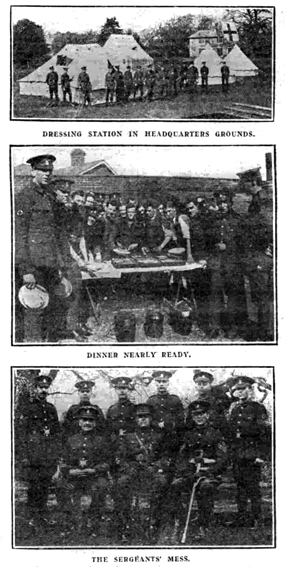
In the following letter sent to The Luton News by Cpl Cyril Gray, 7842, Royal Army Medical Corps, 6th Field Ambulance, one may gather an excellent idea of the real British soldier as he is on the battle front.
The sinking of the Lusitania is assuredly the most hideous crime that has been perpetrated since the infamous Duke of Alva ravaged the Low Countries with fire and sword and torture. We must go back three centuries, that is to say, to find a parallel to the dreadful deed by which the miscreants who direct German policy have crowned a long record of unutterable offences. They have staggered humanity in good sooth. It is not too much to say that this murder of more than one thousand inoffensive travellers had shaken the human world to its foundations.
The 1st Eastern Mounted Field Ambulance have developed into an extremely fit unit in the months which have elapsed since they left Luton.
Woodbridge, the little Suffolk town in which they are quartered, is a place of which the chief characteristics are narrow streets, dangerous corners, quaint old buildings and a more than ample allowance of places of public refreshment.
A Luton man who emigrated to Canada, his Welsh wife and two-year-old son were believed to have perished with the sinking of the RMS Lusitania off the coast of Ireland by a German submarine.
Among the wounded in the fighting for Hill 60 was Pte Albert Kempton, 7886, 1st Battalion Bedfordshire Regiment, whose home is at 1 Chobham Street, Luton. He was buried in a house on which a "Jack Johnson" [large artillery shell] fell, and had a marvellous escape, being brought out later with shrapnel wounds in the leg, while others were killed.
What the Mayor (Councillor Walter Primett) described as "a gross and cruel libel on Luton" was nailed at a meeting of the Town Council on Tuesday evening, when he showed that the estimates of local war babies were exaggerated both in public speech and public mind.
What was commonly known as the war baby question was causing a lot of talk and agitation in the town, which had come in pretty thick for it, said the Mayor. A lady speaker at a meeting in Birmingham was said to have made a statement that 600 war babies were likely to appear in Luton.
The majority of employees of the Skefko Ball Bearing Co Ltd, Leagrave Road, came out on strike on Monday morning. Victimisation of one of their number was alleged as the primary cause, and the men came out when an application by this man to interview one of the directors was refused as he had not taken the usual course of laying his grievance before the works manager.